Swiss Income Tax Rates 2026: Federal, Cantonal & Communal Stack Explained
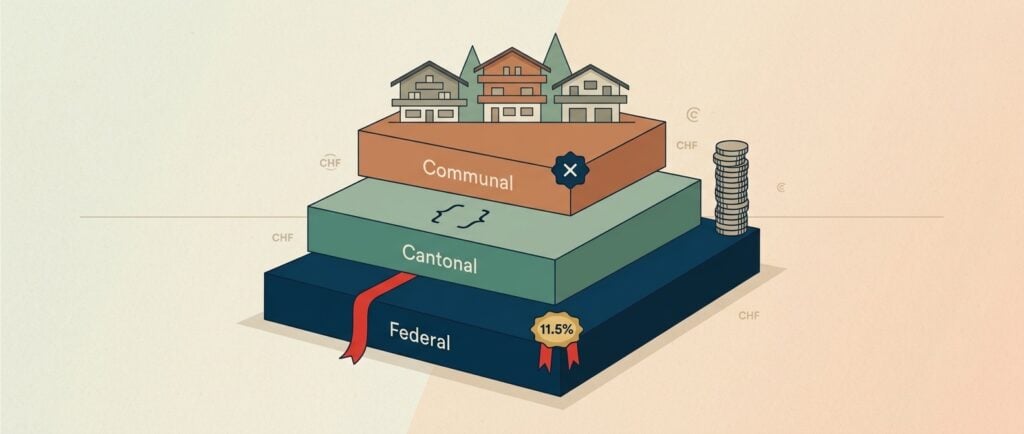
Swiss income tax works in three layers stacked on top of each other, and every Swiss resident pays all three on every franc earned. The Confederation taxes everyone in Switzerland identically (the federal layer). Your canton (one of 26) taxes you on top at rates the canton sets for itself (the cantonal layer). Your commune applies its own percentage on top of the cantonal basic tax (the communal layer). Add the three together and you get your annual income tax bill, which arrives once a year as a single assessment broken out by layer. The federal layer is identical everywhere; the spread between cantons and communes carries the variation. The same CHF 250,000 single income costs CHF 40,072 in Zug Stadt and CHF 80,788 in Lausanne, a CHF 40,716/year gap from canton choice alone. This guide walks through the stack for 2026, the constitutional 11.5% federal cap, the 26-canton effective-rate table at CHF 250,000 single and CHF 350,000 married, and the five levers that actually move the bill.
Key takeaways
- For CHF 250,000 single income at the cantonal capital in 2026, the effective tax rate spans 16.03% in Zug to 32.32% in Lausanne (Vaud), a CHF 40,716 annual delta from canton choice alone (Taxolution 2026 tax model, single filer, no church tax).
- The federal direct tax tops out at 11.5% on income above CHF 794,100 single / CHF 941,500 married (BV Art. 128 Abs. 1 lit. a; DBG Art. 36; ESTV Form. 58c 2026).
- The “highest canton” cluster is wider than Geneva alone. At CHF 250,000 single capital city, Vaud (32.32%), Basel-Land (32.05%), Neuchâtel (32.04%) sit within 0.3 percentage points of each other; Geneva is rank 19 of 26 at 29.25%.
- The “Schwyz lowest” headline is a commune story. Wollerau and Freienbach (CHF 33,345) come in CHF 6,728 cheaper than Zug Stadt, while Schwyz Stadt (CHF 42,739) actually costs more than Zug Stadt because its communal Steuerfuss is 175% versus Zug Stadt’s 52%.
- Five levers actually move the bill at HNW levels: canton choice, commune choice within canton, Pillar 3a, Pillar 2 buy-ins, and lump-sum eligibility for qualifying new arrivals. The Swiss-average top marginal rate sits around 32.5%.
Swiss Income Tax at a Glance (2026)
The four questions every Swiss-resident HNW asks, answered.
Three layers stack on every Swiss-resident income: federal direct tax (DBG, max 11.5%), cantonal income tax (each cantonal Steuergesetz sets its own scale), and a communal Steuerfuss multiplier on top.
Every Swiss tax resident pays all three layers on worldwide income. Foreign nationals on a B permit pay tax-at-source (Quellensteuer) by default until the CHF 120,000 NOV trigger flips them to ordinary assessment.
Tax year 2026 (return filed by 31 March 2027 with extensions). Federal brackets shifted up +0.1% via the EFD’s 11 September 2025 cold-progression adjustment.
On CHF 250,000 single income, moving from Lausanne to Zug saves CHF 40,716/year. On CHF 350,000 married income, Zug-to-Geneva saves CHF 41,016/year (Taxolution 2026 tax model).
What are the Swiss income tax rates in 2026?
Swiss income tax in 2026 ranges from roughly 16% to 32% effective at the cantonal capital on CHF 250,000 single income. The marginal rate on the same income runs from 22% to 46% depending on commune. The next section walks through the federal-cantonal-communal stack and how the three layers combine to produce these spreads.
The federal cap activates above CHF 794,100 single and CHF 941,500 married in 2026. Every franc above those thresholds is taxed federally at exactly 11.5%, flat. The Swiss-average top marginal rate sits around 32.5%, with Schwyz communes (Wollerau, Freienbach) at the low end near 22% and Geneva at the high end above 41% on its top bracket. At the CHF 250,000 reference scenario this guide covers, however, those marginal-top figures don’t apply: the cantonal capital effective spread is roughly 16% to 32%, and the highest-effective cluster is Vaud, Basel-Land, and Neuchâtel, not Geneva.
The 3-tier Swiss tax stack: federal, cantonal, communal
The split is constitutional. BV Art. 128 gives the Confederation a capped income tax. BV Art. 129 Abs. 2 reserves rate-setting sovereignty to the cantons. StHG Art. 1 Abs. 3 harmonises what counts as taxable income (the base) but explicitly leaves rates, brackets, and personal allowances to the cantons. On CHF 250,000 single income, the federal layer is CHF 18,619 in every canton; the cantonal layer carries the bulk of the variation; the communal Steuerfuss multiplies on top.
Layer 1: federal direct tax (DBG)
Federal direct tax tops out at 11.5% on the highest bracket and is identical in every canton (DBG Art. 36, BV Art. 128 Abs. 1 lit. a). It uses progressive brackets running from 0% (below CHF 15,300 single / CHF 29,800 married) up to 11.5% (above CHF 794,100 single / CHF 941,500 married). EFD adjusts bracket boundaries annually for inflation under DBG Art. 39 and BV Art. 128 Abs. 3, the constitutional cold-progression mandate. The 2026 schedule reflects a +0.1% LIK-driven shift versus 2025, the first such shift in three years. Operationally, you don’t file a separate federal return: the cantonal tax administration collects federal direct tax on behalf of the Confederation (BV Art. 128 Abs. 4) inside the same return.
Layer 2: cantonal income tax
Each canton sets its own progressive rate schedule under its own Steuergesetz, within the StHG harmonisation framework. The cantonal basic tax (einfache Staatssteuer) is the figure that gets multiplied; the cantonal Steuerfuss is the percentage applied on top. Cantonal Steuerfuss values vary widely in 2026: Zug 78%, Zürich 95%, Geneva 130.8%, Vaud 147.25%. Effective cantonal rates at CHF 250,000 single capital city range from CHF 9,309 in Schwyz to CHF 47,616 in Basel-Stadt, a more-than-fivefold spread. Curve shape varies too: Zug and Schwyz flatten quickly at HNW levels while Vaud and Geneva keep climbing, which is why canton rankings shift between CHF 250,000 and CHF 1,000,000 income.
Layer 3: communal multiplier (Gemeindesteuerfuss)
The commune applies its own Steuerfuss as a percentage of the cantonal basic tax. Within a single canton, communal Steuerfuss can vary by a factor of 3 or more. In Schwyz canton, Wollerau and Freienbach run at 64% communal Steuerfuss while Schwyz Stadt sits at 175%. In Geneva canton, Cologny and Genthod run at 25% while lower-priced communes climb to 50%. Section 7 details this intra-canton lever.
One outlier: Basel-Stadt has zero municipal tax because the city is the canton. Its cantonal-rate band looks unusually high in the table because it carries the communal load too.
2026 federal direct tax brackets (DBG Art. 36)
The federal direct tax (direkte Bundessteuer) uses progressive brackets defined in DBG Art. 36, indexed annually for inflation under DBG Art. 39 and BV Art. 128 Abs. 3. The 2026 schedule was published as ESTV Form. 58c on 6 January 2026. Bracket boundaries shifted up roughly +0.1% versus 2025: the top single bracket moved from CHF 793,400 to CHF 794,100, the top married bracket from 940,800 to CHF 941,500. Federal direct tax is identical in every Swiss commune; canton and commune drive the 16%-to-32% effective spread.
Two schedules apply, depending on filing status. The first table covers single filers; the second covers married couples (joint filing) and registered partnerships. Each schedule reads the same way: find the bracket your income falls into, take the cumulative tax at the boundary, then add the marginal rate on the excess income above that boundary.
| Income from CHF | Cumulative tax at boundary | Marginal rate above |
|---|---|---|
| 0 – 15,300 | 0.00 | 0.00% (steuerfrei) |
| 15,300 | 0.77 | 0.77% |
| 33,300 | 139.48 | 0.88% |
| 43,600 | 231.84 | 2.64% |
| 58,100 | 614.97 | 2.97% |
| 76,300 | 1,158.44 | 5.94% |
| 82,200 | 1,509.55 | 6.60% |
| 108,900 | 3,271.75 | 8.80% |
| 141,600 | 6,151.55 | 11.00% |
| 185,200 | 10,949.75 | 13.20% |
| 793,900 | 91,298.15 | 13.20% |
| 794,100 | 91,321.50 | 11.50% flat (cap) |
| Income from CHF | Cumulative tax at boundary | Marginal rate above |
|---|---|---|
| 0 – 29,800 | 0.00 | 0.00% (steuerfrei) |
| 29,800 | 1.00 | 1.00% |
| 53,500 | 239.00 | 2.00% |
| 61,400 | 398.00 | 3.00% |
| 79,200 | 933.00 | 4.00% |
| 95,000 | 1,566.00 | 5.00% |
| 108,800 | 2,257.00 | 6.00% |
| 120,700 | 2,972.00 | 7.00% |
| 130,600 | 3,666.00 | 8.00% |
| 138,500 | 4,299.00 | 9.00% |
| 144,400 | 4,831.00 | 10.00% |
| 148,400 | 5,232.00 | 11.00% |
| 150,500 | 5,464.00 | 12.00% |
| 152,500 | 5,705.00 | 13.00% |
| 941,500 | 108,272.50 | 11.50% flat (cap) |
How the 11.5% federal cap works
Above CHF 794,100 single (CHF 941,500 married) in 2026, every additional franc of taxable income is taxed federally at exactly 11.5%, flat, not progressive. This is the constitutional cap (BV Art. 128 Abs. 1 lit. a). The cap has a counterintuitive effect at very high incomes: just below the threshold the federal marginal rate sits at 13.2%, and above it the rate falls back to 11.5%. So a Zug HNW earner at CHF 1,000,000 has a marginal rate of 21.89% (federal cap 11.5% + cantonal+communal ~10%), actually lower than the 23.61% they’d see at CHF 250,000. The federal layer flattens, and only cantonal+communal continues to scale linearly. At CHF 1,000,000 single, the federal tax bill is CHF 114,229.50 in every canton, exactly 11.5% of CHF 993,300 of federal taxable income.
Marginal vs effective tax rate: which one matters for you?
Two rates describe every Swiss tax position. The marginal rate is the rate on your next franc, the figure that decides whether a Pillar 3a contribution, a Pillar 2 buy-in, or a salary bonus is worth the tax it triggers. The effective rate is total tax divided by total taxable income, the figure for comparing cantons or planning year-on-year. The two diverge sharply: at CHF 250,000 single in Zürich, marginal is 38.45% but effective is 25.93%, a 12-point gap. Most rate-overview articles quote one and call it “the rate”. They answer different questions.
Marginal rate: when it matters
Use marginal rate for any decision that adds or subtracts income at the margin. A Pillar 3a contribution of CHF 7,258 reduces taxable income by that amount, saving CHF 7,258 multiplied by your marginal rate. At CHF 250,000 single in Zürich, marginal 38.45% saves roughly CHF 2,790 in tax. In Zug at the same income, marginal 23.61% saves CHF 1,713. Same logic for a Pillar 2 buy-in (Einkauf), a salary-vs-bonus negotiation, or a year-end deductible-expense timing call.
One counterintuitive point. In low-tax cantons, your marginal rate can be lower at very high incomes than at moderate incomes. In Zug, marginal at CHF 250,000 is 23.61%; at CHF 1,000,000 it’s 21.89%. The federal layer drops from the 13.20% bracket to the flat 11.5% cap above CHF 794,100, while Zug’s cantonal+communal stack stays roughly flat at HNW levels. In high-tax cantons (GE, VD), the cantonal curve keeps climbing and marginal rises with income.
Effective rate: when it matters
Use effective rate for canton comparison and after-tax planning. At CHF 250,000 single in Zürich, CHF 64,824 / CHF 250,000 = 25.93% effective. Same income in Schwyz Stadt: CHF 42,739 = 17.10% effective. The 8.83-point gap is CHF 22,085/year. Marginal answers “what does my next franc cost?”. Effective answers “what’s my real take-home percentage?”. Both matter.
Effective tax rate by canton in 2026 (CHF 250k single + CHF 350k married)
The 26-canton effective-rate table at HNW reference incomes is the data centerpiece of this guide. The 2026 figures below combine federal, cantonal and communal layers at the capital city of each canton, for a single filer earning CHF 250,000 and a married single-earner couple at CHF 350,000, with no church tax and no extraordinary deductions. Federal tax is identical at CHF 18,619 across every canton at CHF 250,000 single, and CHF 29,768 at CHF 350,000 married; the variance is entirely cantonal+communal.
| Canton (capital) | 250k single CHF | 250k single eff% | 350k married CHF | 350k married eff% |
|---|---|---|---|---|
| ZG Zug | 40,072 | 16.03% | 57,491 | 16.43% |
| SZ Schwyz | 42,739 | 17.10% | 62,130 | 17.75% |
| AI Appenzell | 47,998 | 19.20% | 70,423 | 20.12% |
| OW Sarnen | 48,490 | 19.40% | 70,850 | 20.24% |
| UR Altdorf | 50,256 | 20.10% | 73,242 | 20.93% |
| NW Stans | 51,756 | 20.70% | 76,266 | 21.79% |
| LU Luzern | 53,410 | 21.36% | 78,620 | 22.46% |
| SH Schaffhausen | 56,804 | 22.72% | 81,072 | 23.16% |
| AG Aarau | 61,278 | 24.51% | 84,722 | 24.21% |
| TG Frauenfeld | 61,277 | 24.51% | 85,534 | 24.44% |
| GR Chur | 61,407 | 24.56% | 86,237 | 24.64% |
| GL Glarus | 61,809 | 24.72% | 87,660 | 25.05% |
| ZH Zürich | 64,824 | 25.93% | 91,247 | 26.07% |
| AR Herisau | 65,380 | 26.15% | 93,946 | 26.84% |
| BS Basel | 66,235 | 26.49% | 92,642 | 26.47% |
| SG St. Gallen | 68,510 | 27.40% | 95,859 | 27.39% |
| SO Solothurn | 70,607 | 28.24% | 99,461 | 28.42% |
| TI Bellinzona | 70,837 | 28.33% | 103,456 | 29.56% |
| GE Genève | 73,123 | 29.25% | 98,507 | 28.14% |
| BE Bern | 75,077 | 30.03% | 106,445 | 30.41% |
| JU Delémont | 75,080 | 30.03% | 103,281 | 29.51% |
| FR Fribourg | 75,904 | 30.36% | 105,611 | 30.17% |
| VS Sion | 76,270 | 30.51% | 103,062 | 29.45% |
| NE Neuchâtel | 80,112 | 32.04% | 112,706 | 32.20% |
| BL Liestal | 80,125 | 32.05% | 108,610 | 31.03% |
| VD Lausanne | 80,788 | 32.32% | 110,501 | 31.57% |
Three patterns surface. The lowest cluster runs ZG, SZ, AI, OW, UR, NW, LU, all under 22% effective at CHF 250,000 single. The high cluster is VD/BL/NE, three cantons within 0.3 points of each other above 32%, with Geneva at 29.25% (rank 19 of 26) below all three. Basel-Stadt’s 26.49% looks middle-of-pack, but notice CHF 0 communal tax: BS is the city-canton outlier discussed in section 7.
The progression table below answers a different question: how does your rate scale as income climbs into very high HNW territory? Two effects matter most. The federal layer flattens above the 11.5% cap; cantonal+communal continues to scale roughly linearly. The CHF-value of canton choice grows materially with income, even when the percentage spread narrows.
| Canton | CHF 250k single | CHF 500k single | CHF 1M single | CHF 1.5M single |
|---|---|---|---|---|
| SZ Schwyz | 17.10% / CHF 42,739 | 21.82% / CHF 109,106 | 23.12% / CHF 231,154 | 23.21% / CHF 348,092 |
| ZG Zug | 16.03% / CHF 40,072 | 19.81% / CHF 99,072 | 21.37% / CHF 213,683 | 21.55% / CHF 323,183 |
| ZH Zürich | 25.93% / CHF 64,824 | 33.37% / CHF 166,826 | 36.85% / CHF 368,533 | 37.68% / CHF 565,133 |
| VD Lausanne | 32.32% / CHF 80,788 | 39.79% / CHF 198,949 | 41.16% / CHF 411,560 | 41.27% / CHF 619,060 |
| GE Genève | 29.25% / CHF 73,123 | 36.04% / CHF 180,191 | 40.03% / CHF 400,301 | 41.10% / CHF 616,462 |
| ZG → VD spread | CHF 40,716 | CHF 99,877 | CHF 197,877 | CHF 295,877 |
Effective income tax rate by income, single filer, capital city, 2026
Lines flatten above the federal 11.5% cap; cantonal+communal continue to scale
Two stories. First, the federal cap means the federal layer flattens above CHF 794,100; past that point, all rate variance is cantonal+communal. Second, even when percentage spreads narrow at very high incomes, the CHF-value of canton choice keeps growing. ZG-to-VD widens from CHF 40,716 at 250k to CHF 295,877 at 1.5M, a 5.6× growth. Canton choice gains value as income climbs.
Top 5 lowest and top 5 highest cantons at HNW reference incomes
The lowest five capital cities at CHF 250,000 single in 2026 are Zug (16.03%), Schwyz (17.10%), Appenzell-Innerrhoden (19.20%), Obwalden (19.40%) and Uri (20.10%). The highest five are Vaud Lausanne (32.32%), Basel-Land Liestal (32.05%), Neuchâtel (32.04%), Valais Sion (30.51%) and Fribourg (30.36%). Geneva ranks 19 of 26 at this scenario, despite top-bracket rankings that put Geneva first at very high incomes. Override the scenario with your own income, marriage status, and canton in the calculator below.
Swiss Income Tax Stack
See your 2026 federal + cantonal + communal split for any canton at any income.
Total effective income tax at the cantonal capital, 2026 rates. No church tax, no children, no extraordinary deductions.
Need help optimizing your Swiss tax situation?
Schedule a free consultationThe Zug-to-Geneva spread: how much canton choice is worth at HNW
Canton choice is the largest single income tax lever for a Swiss-resident HNW earner, bigger than any deduction, bigger than Pillar 3a or Pillar 2 buy-ins. On CHF 250,000 single, Lausanne-to-Zug saves CHF 40,716/year (16.03% vs 32.32%). On CHF 350,000 married, Zug-to-Geneva saves CHF 41,016/year (16.43% vs 28.14%). At CHF 1,000,000 single, Zug-to-Vaud climbs to CHF 197,877/year. Compounded over a 20-year career, that’s CHF 800,000 to CHF 4 million of preserved capital depending on income, before reinvestment.
The “highest tax canton” is not Geneva. At HNW reference incomes, the top is the VD/BL/NE cluster: Vaud Lausanne 32.32%, Basel-Land Liestal 32.05%, Neuchâtel 32.04%, all within 0.3 points of each other. Articles that put Geneva at the top usually quote top-bracket marginal rates (around 41.6%) that only kick in above CHF 800,000. At CHF 250,000 capital city, Geneva sits at 29.25%, rank 19 of 26.
The CHF lever: worked example
Take a CHF 250,000 single earner choosing between Zug Stadt and Genève city in 2026. Zug Stadt: federal CHF 18,619 + cantonal CHF 12,872 + communal CHF 8,581 = CHF 40,072 total, 16.03% effective. Genève city: federal CHF 18,619 + cantonal CHF 40,446 + communal CHF 14,058 = CHF 73,123, 29.25% effective. The CHF 33,051 annual delta is canton+commune; federal adds zero variance. Compounded 20 years at 0% return, CHF 661,020 of preserved gross income; at 4% real return, roughly CHF 1.0 million.
Move the comparison to Lausanne and the gap widens: VD Lausanne CHF 80,788 vs ZG Zug CHF 40,072, a CHF 40,716 annual delta. Vaud is consistently more expensive than Geneva city at HNW reference incomes despite Geneva’s higher cantonal Steuerfuss (130.8 vs 147.25), because Lausanne’s communal Steuerfuss of 78.5% sits well above Genève city’s 45.49%. The lump-sum taxation guide covers the alternative regime worth considering at CHF 1 million-plus arrivals.
When canton choice isn’t actually possible
Three hard constraints limit canton choice. Employer location: if your contract requires Zürich or Geneva physical presence five days a week, parking in Schwyz Wollerau means a punishing commute. Family-anchor effects: schools, spouse career, children’s social network, healthcare continuity all lock you into a corridor. Cross-border commute realities. In our experience, realistic canton choice is usually a 2-to-3 canton shortlist within commuting distance of the work address. The decision is also a planning lever for new arrivals that compounds with mortgage structuring, Pillar 3a setup, and Pillar 2 buy-in decisions in year one.
Swiss Tax Burden by Canton
Total effective tax rate (federal + cantonal + municipal), 2025 rates. Switch between income and wealth tax.
Total effective income tax rate (federal + cantonal + municipal), 2025 rates
Need help optimizing your Swiss tax situation?
Schedule a free consultationHow communal multipliers (Steuerfuss) shape your bill within a canton
Within a single canton, the commune you live in materially changes the bill. The cantonal income tax is multiplied by a communal Steuerfuss set independently by each commune. Wollerau and Freienbach (SZ) at 64% versus Schwyz Stadt at 175% means a CHF 250,000 single earner pays CHF 9,394 less in Wollerau than Schwyz Stadt. Wollerau (CHF 33,345) actually comes in CHF 6,728 cheaper than even Zug Stadt. This is the intra-canton lever HNW residents pull most often.
The Steuerfuss mechanism
The cantonal Tarif gives a basic-tax CHF figure (einfache Staatssteuer). Each commune sets its own Steuerfuss; the cantonal+communal bill is the basic tax multiplied by (cantonal Steuerfuss + communal Steuerfuss + parish Steuerfuss, where applicable). If your einfache Staatssteuer is CHF 20,000 and you live in Zürich Stadt (cantonal 95% + communal 119% = 214% combined), your bill is CHF 42,800. Move 15 minutes south to Kilchberg (communal 72%) and the same CHF 20,000 becomes CHF 33,400. The same mechanism applies to cantonal wealth tax, so an intra-canton move stacks across both bills.
Basel-Stadt is the structural exception: zero municipal tax, because the city is the canton. Vaud reports a split coefficient, 147.25/155: 147.25 for ordinary cantonal income tax, 155 for the 10% surtax. Valais uses its own progressive-index notation. The notation differs across cantons but the underlying mechanism, basic tax multiplied by a coefficient, is identical.
Notable low-Steuerfuss communes by canton
| Canton | Capital city total | Lowest commune | Communal Steuerfuss | Lowest commune total | CHF saved vs capital |
|---|---|---|---|---|---|
| SZ Schwyz | CHF 42,739 | Wollerau / Freienbach | 64 | CHF 33,345 | CHF 9,394 |
| ZG Zug | CHF 40,072 | Baar | 47.53 | CHF 39,335 | CHF 738 |
| NW Nidwalden | CHF 51,756 | Hergiswil NW | 120 | CHF 44,161 | CHF 7,594 |
| GE Genève | CHF 73,123 | Cologny / Genthod | 25 | CHF 66,791 | CHF 6,332 |
| ZH Zürich | CHF 64,824 | Kilchberg | 72 | CHF 54,682 | CHF 10,143 |
| VD Vaud | CHF 80,788 | Saint-Sulpice | 55 | CHF 74,317 | CHF 6,472 |
Two patterns. Schwyz canton has the largest within-canton commune headroom of any Swiss canton; Wollerau and Freienbach (the “Goldküste” baseline) beat Schwyz Stadt and Zug Stadt. Nidwalden’s low-tax brand at the canton level (Stans is rank 6 of 26 capitals) doesn’t transfer to its communes the way SZ does: Hergiswil at CHF 44,161 is more expensive than Schwyz Stadt. NW is “nice canton, mediocre communes” compared to SZ.
The most common pattern we see for HNW Zürich employees is the move from Zürich Stadt to Kilchberg or Küsnacht. Same canton, same employer, a 15-to-30-minute lake-bus or S-Bahn commute, roughly CHF 10,000/year saved on CHF 250,000 single. That’s the highest-impact canton-internal move in German-speaking Switzerland.
Married vs single: how Swiss tax splitting actually works
Switzerland taxes married couples jointly. Both incomes are added; the joint figure is taxed using the married-filer schedule (DBG Art. 36 Abs. 2 federally; cantonal scales separately). The federal schedule is built so the rate on joint income approximates the rate on half the income applied twice, an implicit splitting mechanism. At cantonal level, splitting works differently. Some cantons use Vollsplitting (divisor 2). Others use Teilsplitting (divisor 1.6 to 1.9). A few use a married-rebate approach. The result varies materially by canton.
At HNW reference points in 2026, married couples on CHF 350,000 joint pay between 16.43% effective in Zug Stadt (CHF 57,491) and 32.20% in Neuchâtel (CHF 112,706). The Zug-to-Neuchâtel spread is CHF 55,215/year. Compared to the CHF 40,716 single-filer ZG-to-VD spread on CHF 250,000 single, the canton-choice CHF lever is roughly proportional to taxable income at HNW levels.
The federal splitting mechanism
Federal direct tax for married filers uses the joint-filer bracket schedule (DBG Art. 36 Abs. 2). The schedule is built so the rate on joint income approximates the rate two singles each on half the income would pay. A married couple with CHF 350,000 of joint income (one spouse earning, the other not) pays federal CHF 29,768 in 2026. Two singles each at CHF 175,000 pay federal CHF 9,089 each, totalling CHF 18,178. The joint federal bill is higher by CHF 11,590. That’s the federal slice of the marriage penalty: when both notional spouses earn similarly, the joint-progression bump outweighs the splitting effect.
The penalty exists across most cantons at certain income mixes and is the policy context for the 2026 individual-taxation referendum. It narrows or reverses when one spouse earns much more than the other. Single-earner HNW households typically benefit from joint filing; dual-earner households at similar incomes are where the penalty bites.
Cantonal splitting variation
Vollsplitting (Zürich, Aargau, Basel-Land) takes joint income, divides by 2, applies the rate, multiplies by 2. Teilsplitting (Bern, Luzern, Solothurn) divides by 1.6 to 1.9, giving smaller relief. Geneva, Vaud and Valais use a family-coefficient (quotient familial) or married-rebate approach that produces a similar effect through different machinery.
At the HNW scale this guide targets, federal-side splitting does NOT prevent a marriage penalty. Two singles each at CHF 175,000 in Geneva pay CHF 42,919 each (federal CHF 9,089 + cantonal+communal CHF 33,831), totalling CHF 85,838. A Geneva single-earner couple at CHF 350,000 pays CHF 98,507. Penalty: CHF 12,669/year. Same comparison in Zug: two singles each at CHF 175,000 pay CHF 22,742 each, totalling CHF 45,484; a single-earner couple at CHF 350,000 pays CHF 57,491. Penalty: CHF 12,007/year. At lower joint incomes (CHF 100-150k), federal splitting usually leaves married couples better off than two singles. At CHF 350k+ that flips: the joint-progression bump outweighs splitting, and cantonal splitting only marginally narrows the gap, leaving the federal-layer penalty of CHF 11,590 mostly intact. Run your specific income mix in the calculator above.
Tax-at-source vs ordinary assessment for high earners
Foreign nationals on a B permit working physically in Switzerland pay tax-at-source (Quellensteuer) by default. Your employer withholds monthly at a tariff-code rate (A, B, C, H, G) based on family status and approximate income. Above CHF 120,000 of annual gross employment income, the federal threshold triggers a flip to mandatory ordinary assessment, NOV (Nachträgliche Ordentliche Veranlagung), and you file a regular tax return. The legal basis sits in DBG Art. 89 Abs. 1 lit. a and Abs. 2 plus QStV Art. 9 Abs. 1. Once you cross the CHF 120,000 threshold in any year, you stay on ordinary assessment in subsequent years; the flip is one-way for as long as you remain on a B permit (DBG Art. 89 Abs. 5). For HNW expats, ordinary assessment is almost always the better option: at-source tariff codes apply standardised deductions that can’t capture Pillar 3a, Pillar 2 buy-ins, mortgage interest, property maintenance, or extraordinary deductions. NOV opens the full Swiss deduction toolkit.
When at-source becomes ordinary: the CHF 120,000 trigger
The federal trigger is CHF 120,000 of gross annual employment income on a single Quellensteuer-pflichtige person (DBG Art. 89 Abs. 1 lit. a, QStV Art. 9 Abs. 1). The figure has been unchanged since 1 January 2021. Above the threshold, NOV is mandatory and continuous; below it, NOV-on-application is available under DBG Art. 89a, with a deadline of 31 March of the following year. Cross-border workers (Wochenaufenthalter) follow DBG Art. 99a, with a stricter 90%-of-worldwide-income test. About a third of HNW arrivals on B permits we onboard cross the threshold in their first full year, and most are surprised to learn the flip is one-way.
Why HNW arrivals usually want ordinary
At-source rates apply standardised deductions that can’t be optimised. NOV lets you claim Pillar 3a (CHF 7,258 saving CHF 1,700 to CHF 2,800 at HNW marginal rates), Pillar 2 buy-ins (potentially CHF 100,000+ deductions in a single year), commute, professional expenses, mortgage interest, property maintenance, and extraordinary deductions. For an HNW arrival, the year-one NOV-vs-at-source delta is typically CHF 10,000 to CHF 25,000 of optimisable tax. The full withholding tax (Quellensteuer) guide covers the at-source side; check whether you should file an NOV this year with the NOV eligibility checker.
What’s new in 2026: cold progression adjustment and other changes
The federal Tarif 2026 reflects the EFD’s annual cold-progression adjustment (DBG Art. 39, BV Art. 128 Abs. 3). The 2026 schedule lifted bracket thresholds by +0.1% versus 2025, the LIK-driven shift announced in the EFD press release of 11 September 2025. The top single bracket shifted by CHF 700 (793,400 → 794,100) and the top married bracket by CHF 700 too (940,800 → 941,500). Beyond cold progression, three other 2026 changes affect HNW Swiss-resident taxpayers.
Cold progression: how the bracket indexation works
Cold progression (kalte Progression) adjusts every federal bracket threshold annually for inflation, using the Landesindex der Konsumentenpreise (LIK). When LIK rises, EFD shifts every bracket boundary up by the same percentage. The mechanism is statutory under DBG Art. 39 and constitutionally mandated under BV Art. 128 Abs. 3. Cantonal adjustments work differently: some adjust automatically when CPI passes a fixed threshold (typically 3% to 7% cumulative); others require legislative action. Check your cantonal Steuergesetz before assuming federal-style indexation at the cantonal layer.
Other 2026 changes worth knowing
Pkw-Kilometerabzug raised CHF 0.70 to CHF 0.75 per kilometre. The private-vehicle commute deduction rose for 2026, now indexed annually to TCS-Referenzwerten. It interacts with the federal CHF 3,000/year commuting cap and with cantonal limits. Full mechanics sit in the Swiss tax deductions guide.
Lump-sum taxation floor raised CHF 429,100 to CHF 435,000. The federal minimum taxable expenditure for the alternative lump-sum taxation regime rose by CHF 5,900 for 2026 (DBG Art. 14 Abs. 3 lit. a). Cantonal floors stack on top, often higher.
Pillar 3a contribution caps unchanged for 2026. The cap stays at CHF 7,258 with a 2nd pillar (employees in a BVG plan) and CHF 36,288 without (self-employed). At HNW marginal rates, the CHF 7,258 employee cap saves between CHF 1,713 (Zug, 23.61% marginal) and CHF 3,332 (Lausanne, 45.93% marginal) per year.
Eigenmietwert reform timeline. Federal abolition is confirmed for 1 January 2029 per the Bundesrat April 2026 communiqué. Tax years 2026, 2027 and 2028 are the last three where current property-deduction rules apply federally. Owner-occupiers planning major maintenance should read the property maintenance deductions guide alongside the imputed rental value page; the timing levers compress between now and the 2029 cliff.
How to lower your Swiss income tax (legitimately): the 5 levers
Five levers, in rough CHF magnitude: canton choice, commune within canton, Pillar 3a, Pillar 2 buy-ins, and lump-sum eligibility for qualifying first-time arrivals. The right combination depends on your income mix, your canton, and your long-term plans, and lever 1 alone (the CHF 40,716 Zug-to-Lausanne spread on CHF 250,000 single) typically dominates.
Lever 1: Canton choice
The biggest lever, worth 13-to-20 percentage points effective at HNW reference incomes. CHF 40,716/year on CHF 250,000 single (Zug-to-Lausanne); CHF 41,016/year on CHF 350,000 married (Zug-to-Geneva); CHF 197,877/year at CHF 1,000,000 single. Constrained by employer location, family-anchor effects, and commute realities. Pre-arrival HNW expats have the cleanest version of this decision. The tax burden calculator ranks all 26 cantons at your specific income.
Lever 2: Commune choice within canton
The intra-canton lever, especially powerful in SZ and ZH. Wollerau or Freienbach in Schwyz canton beats Schwyz Stadt by CHF 9,394/year and Zug Stadt by CHF 6,728. Kilchberg or Küsnacht in Zürich canton beats Zürich Stadt by CHF 10,143/year. Cologny or Genthod in Geneva canton beats Genève city by CHF 6,332. Use this when canton choice is constrained by employer location but commune is open.
Lever 3: Pillar 3a contribution
CHF 7,258/year (with a 2nd pillar) saves CHF 1,700 to CHF 3,300 in tax at HNW marginal rates depending on canton. The Pillar 3a guide covers contribution rules, withdrawal mechanics and product structure. Run your canton’s specific saving in the Pillar 3a savings calculator. The CHF 36,288 self-employed cap (without a 2nd pillar) is materially larger and worth considering if you have a self-employment income strand.
Lever 4: Pillar 2 buy-ins (Einkauf)
Larger irregular deductions, potentially CHF 100,000+ in a single year, depending on the gap between your current vested capital and your fund’s regulatory ceiling. The deduction sweeps DOWN the bracket curve, so the relevant rate is the average rate over the deduction range, not the headline marginal rate at the top. A CHF 100,000 buy-in at CHF 250,000 single in Zürich Stadt saves about CHF 31,300 (a ~31.3% average rate over the [150k, 250k] deduction range, computed as the differential between your tax with and without the buy-in). The three-year withdrawal block under Art. 79b Abs. 3 BVG applies across all your Swiss pension funds (Gesamtbetrachtung doctrine, BGer 2C_488/2014). Spreading the buy-in across years harvests the steepest bracket each year. Mechanic, jurisprudence, and the 5 eligibility gates: see our Pillar 2 buy-in guide and run the numbers in the Pillar 2 buy-in calculator.
Lever 5: Lump-sum eligibility for new arrivals
Available only to non-Swiss-citizen first-time residents (or returning after 10 years away) with no Swiss gainful activity. You pay tax on deemed expenditure (CHF 435,000 federal floor in 2026, often higher cantonal floor) instead of worldwide income, under the lump-sum taxation regime. Valuable for HNW arrivals with worldwide income above roughly CHF 1 million. Check break-even in the lump-sum break-even calculator. Five cantons (ZH, BL, BS, SH, AR) have abolished the regime; 21 retain it.
Frequently asked questions
What is the income tax rate in Switzerland in 2026?
Effective rates range from 16% to 32% at the cantonal capital on CHF 250,000 single income. Federal direct tax alone tops out at 11.5% (BV Art. 128 Abs. 1 lit. a, DBG Art. 36) above CHF 794,100 single / CHF 941,500 married. Combined federal+cantonal+communal at HNW levels runs from 16.03% in Zug to 32.32% in Lausanne. Marginal rates above the federal cap reach 22% in low-tax communes and 46% in Lausanne (Taxolution 2026 tax model).
What’s the lowest income tax canton in Switzerland 2026?
Schwyz at the canton level, with Wollerau and Freienbach communes pushing combined rate to roughly 13% effective at CHF 250,000 single. Zug ranks first among capital cities. Top-bracket marginal rates run around 22% in Schwyz and Zug at the low end and 41% to 42% in Geneva and Vaud at the high end, but those apply only on income above CHF 800,000.
How much income tax do I pay on CHF 250,000 in Switzerland?
Between CHF 40,072 (Zug Stadt) and CHF 80,788 (Lausanne) at the cantonal capital, single filer, no church tax, no extraordinary deductions, in 2026. The federal portion is CHF 18,619 in every canton. The CHF 40,716 spread is entirely cantonal+communal. Run your specific canton, commune, marriage status and deduction profile in the income-tax-stack calculator above.
What is the federal direct tax cap in Switzerland?
11.5%. Above CHF 794,100 single / CHF 941,500 married income (2026 thresholds), every additional franc is taxed federally at exactly 11.5% flat, not the marginal-bracket rate (BV Art. 128 Abs. 1 lit. a; DBG Art. 36; ESTV Form. 58c 2026). Cantonal and communal layers continue to apply, so total effective rate can still reach 41% in Vaud or Geneva at CHF 1,000,000.
Is Switzerland a high-tax country for HNW individuals?
Mixed answer. At capital cities in low-tax cantons (Schwyz, Zug, Nidwalden, Obwalden), Switzerland is materially below France, Germany, UK and US for HNW (effective 16% to 21% on CHF 250,000 single). In high-tax cantons (Vaud, Basel-Land, Neuchâtel, Geneva, Bern), Switzerland is roughly comparable to mid-European burdens (28% to 32%). The Swiss-average top marginal rate sits around 32.5%, slightly down from prior years.
How does Swiss tax splitting work for married couples?
Joint income is added; the joint figure is taxed using the married-filer schedule (DBG Art. 36 Abs. 2 federally). Federal direct tax applies an implicit splitting (the schedule is built so the rate on joint income approximates the rate on half the income applied twice). Cantons split via Vollsplitting (divisor 2), Teilsplitting (divisor 1.6 to 1.9), or family-quotient (Geneva, Vaud, Valais). At HNW joint incomes around CHF 350,000, federal-side splitting does not prevent a marriage penalty: federal alone produces a CHF 11,590/year penalty, and cantonal layers shift it only marginally. See the marriage penalty guide.
Do I have to pay tax on worldwide income in Switzerland?
Yes, if you’re a Swiss tax resident. Switzerland taxes residents on worldwide income and worldwide wealth (DBG Art. 6). Foreign-source income is exempted-with-progression under most double-taxation agreements. Lump-sum taxation is the alternative regime for qualifying non-Swiss-citizen new arrivals. See the worldwide-income guide and the lump-sum taxation guide.
What’s the difference between Quellensteuer and ordinary income tax in Switzerland?
Quellensteuer (tax-at-source) is monthly withholding by the employer at tariff-code rates (A, B, C, H, G), default for foreign nationals on a B permit. Ordinary assessment is the regular annual tax return Swiss residents file. Above CHF 120,000 of gross employment income, NOV (mandatory ordinary assessment, DBG Art. 89 Abs. 1 lit. a, QStV Art. 9 Abs. 1) kicks in. For HNW expats, ordinary opens the full deduction toolkit, usually CHF 10,000 to CHF 25,000 more optimisable. See the withholding tax guide.
Swiss income tax in 2026 is a 3-tier stack: a federal direct tax capped at 11.5% (DBG Art. 36, BV Art. 128 Abs. 1 lit. a), a cantonal income tax that varies up to 4× across the 26 cantons, and a communal Steuerfuss multiplier that varies again within each canton. The federal layer is identical at every commune; cantonal and communal carry the variance. CHF 250,000 single generates a CHF 40,072 bill in Zug Stadt and CHF 80,788 in Lausanne, with the federal slice (CHF 18,619) the same in both.
Canton choice is the largest income-tax lever for a Swiss-resident HNW earner: CHF 40,716/year on CHF 250,000 single, CHF 41,016 on CHF 350,000 married, CHF 197,877 at CHF 1,000,000 single. Constrained by employer location, family anchor, and commute realities, but worth modelling against any plausible canton shortlist before signing a lease. The five levers: canton choice, commune choice within canton, Pillar 3a, Pillar 2 buy-ins, and lump-sum eligibility for qualifying non-Swiss-citizen first-time arrivals. Canton choice as a planning lever for new arrivals compounds with mortgage structuring, Pillar 3a setup, and Pillar 2 buy-in scheduling in year one. Run the numbers, then pick.
Plan the canton + commune decision before you sign the lease.
We model the Swiss-side income tax outcome canton by canton, run the commune-level Steuerfuss optimisation, and stress-test the NOV vs lump-sum decision against your specific income mix. For US citizens, we coordinate with your US-side advisor.
Table of Contents
Latest blog posts
Swiss Expat Tax Benefits 2026: Special Tax Deductions for Posted Employees
In this article, we explain what the special “expat” status is all about, how an expat differs from other employees in Switzerland, and what benefits you can derive from it if you also belong to this group.

Is Switzerland Still a Tax Haven in 2026? How Much You Actually Pay vs the EU, UK, UAE & Monaco
Switzerland isn’t classically a tax haven, but for high earners the structural mix beats every EU comparator. Take-home and wealth tax compared to UAE, Monaco, UK, Germany, Italy, more.
Swiss Pillar 2 Buy-In 2026: Tax Savings, the 3-Year Withdrawal Block, and When It’s Worth It
Many pension funds advertise voluntary purchases and present attractive calculation models to interested parties. What is often not mentioned is that the voluntary purchase into the pension fund is not worthwhile for everyone and does not always help with tax savings.