Hiring in Switzerland: What UK Businesses Need to Know
A lot of growing UK companies are keen on expanding their workforce by tapping into Switzerland’s skilled talent pool. Perhaps your ideal candidate resides in Zurich or Zug. While the talent opportunity is clear, navigating the intricate rules around employment, taxation, and social insurance between the two countries can seem daunting.
Understanding how to effectively and legally employ Swiss-based individuals ensures smooth operations, prevents regulatory pitfalls, and optimizes financial efficiency.
Common Challenges for UK Employers
Social Security Coordination
When employing someone residing in Switzerland, UK employers must grapple with social security considerations. Switzerland has strict rules ensuring workers receive adequate social insurance coverage. Fortunately, the UK and Switzerland have a bilateral social security agreement. However, complexities arise around eligibility, ensuring contributions to the correct social security system, and the associated administrative responsibilities.
Therefore, it is critical for both parties to determine quickly which country’s system the employee must be affiliated with—either upon relocation to Switzerland or at the start of the employment if the person already lives there. A common misconception is that liabilities begin only after a contract is signed or once payroll switches to the other country. In reality, affiliation obligations can trigger earlier, often with the actual relocation date of the employee, and failing to act in time may lead to incorrect contributions. It’s better to clarify in advance which system (UK or Swiss) should handle the payments, since reclaiming money later can be complicated and time-consuming.
The social security agreement between the UK and Switzerland clearly outlines which country’s rules apply. Two provisions are especially relevant in most cases:
- Art. 13 Abs. 3 lit. a: “Personen, die in einem Staat eine Beschäftigung oder selbstständige Erwerbstätigkeit ausüben, unterliegen den Rechtsvorschriften dieses Staates.” In essence, this means that individuals working in one state are subject to that state’s social security laws.
- Art. 15 Abs. 1: “Eine Person die gewöhnlich eine Beschäftigung in beiden Staaten ausübt, unterliegt den Rechtsvorschriften des Wohnstaates, wenn sie dort einen wesentlichen Teil ihrer Tätigkeit ausübt.” This applies to multi-state employment scenarios, stating that if a person works in both countries and performs a substantial part of their work in their country of residence, then that country’s system applies.
Employers should assess the employee’s work schedule and residence situation early to figure out which country’s rules apply, using these articles as a guideline. Two basic examples help clarify this:
- If an employee works 95% of their time in Switzerland, they must be affiliated with the Swiss social security system.
- If an employee works 95% of their time in the UK, even if they reside in Switzerland (e.g. returning to family in CH on weekends), they remain subject to the UK system.
Cases that aren’t clearly one way or the other should be assessed carefully. Established practice helps interpret what qualifies as “a substantial part” of work, particularly under Art. 15.
In typical cases where an employee of a UK employer mainly works in Switzerland, the treaty usually requires the employer to follow Swiss social security rules. This means that both the employee and employer share responsibility for paying contributions into the Swiss system.
This is grounded in Art. 18 para. 1 of the agreement:
“Hat ein Arbeitgeber seinen eingetragenen Sitz oder seine Niederlassung ausserhalb des zuständigen Staates, so hat er allen Pflichten nachzukommen, die die auf seine Arbeitnehmer anzuwendenden Rechtsvorschriften vorsehen, namentlich der Pflicht zur Zahlung der nach diesen Rechtsvorschriften vorgeschriebenen Beiträge, als hätte der Arbeitgeber seinen eingetragenen Sitz oder seine Niederlassung in dem zuständigen Staat.”
English translation: An employer without a registered seat or permanent establishment in the competent state is still obligated to fulfill all duties under the applicable social security laws for its employees, as if it were established there. That includes payment of all required contributions.
Once this obligation is established, the parties must decide who handles the administrative execution:
- Either the employer pays the contributions itself, through a Swiss contact point such as us that handles the payroll figures, the invoices and the correspondence with the compensation office and the insurers.
- Or the employee may assume these obligations on behalf of the employer.
This second option is allowed under Art. 18 para. 2, which reads:
“Ein Arbeitgeber, der keinen eingetragenen Sitz oder eine Niederlassung in dem Staat hat, dessen Rechtsvorschriften anwendbar sind, und der Arbeitnehmer können vereinbaren, dass Letzterer die Pflichten des Arbeitgebers zur Zahlung der Beiträge wahrnimmt, ohne dass die daneben fortbestehenden Pflichten des Arbeitgebers berührt würden. Der Arbeitgeber übermittelt eine solche Vereinbarung dem zuständigen Träger dieses Staates.”
In English: An employer without a registered seat or branch in the country whose laws apply can agree with the employee that the employee will take over the employer’s duties related to the payment of contributions—without this relieving the employer of its formal obligations. Such an agreement must be submitted to the Swiss social security authority.
This second option is often more practical and cost-effective in lower-risk cases, but it relies on the employee accurately and consistently fulfilling their responsibilities.
Another part of the access to the Swiss system is compliance with mandatory insurances. The treaty ensures that employees working in Switzerland receive the same level of protection as local employees. This includes several key components:
- Mandatory accident insurance (UVG): UVG stands for “Unfallversicherungsgesetz” (Swiss Accident Insurance Law), which requires coverage for occupational and non-occupational accidents. It is important to note that accident insurance offered through private health insurance policies, such as those based on KTG (Krankentaggeldversicherung or daily sickness allowance insurance), is not compliant with UVG standards. Employers must ensure that proper UVG-based accident insurance is in place.
- Occupational pension plan (BVG): BVG refers to the “Berufliche Vorsorgegesetz” (Occupational Pensions Act), mandating contributions to a second-pillar pension scheme. This ensures that employees in Switzerland build up retirement benefits comparable to domestic peers.
- Family allowances and unemployment insurance: Employees must also be integrated into the Swiss system for cantonal family allowances and be insured for unemployment benefits, enabling them to receive support in case of job loss.
Let’s take a closer look at two common pitfalls that UK employers face when engaging Swiss-based employees:
- Continuing UK Payroll After Relocation to Switzerland
One of the most frequent missteps is failing to adapt the employment structure after the employee relocates to Switzerland. In many cases, UK employers continue paying salaries via UK payroll without notifying Swiss authorities or switching the insurance setup—despite the employee now physically working in Switzerland.
This often stems from false assumptions about grace periods or thresholds (e.g., minimum duration of presence in Switzerland) before a change becomes necessary. In practice, these thresholds often do not apply. For social security purposes, the Swiss compensation office typically references the date of official registration (Anmeldung) in Switzerland and will expect contributions from that month onward. Even if contributions were made in the UK during that period, Switzerland may assert its right to collect, potentially leading to a situation where the employer must retroactively claim a refund from UK institutions. The same reasoning applies to tax obligations if workdays took place in Switzerland.
- Unclear Presence and Delayed Action
Some employment situations involve more fluid transitions, such as partial relocation, remote work arrangements, or undefined plans to move. This ambiguity often leads to procrastination: neither party formally adjusts the employment model or notifies authorities.
However, ambiguity does not eliminate liability. In such dynamic cases—where it’s unclear whether the employee has “moved” in the legal sense or where work is performed across jurisdictions—it’s crucial to conduct a proper legal analysis. Work out the route before payroll starts, for example with the two-question chart in our guide. For certainty on the tax side, a ruling from the cantonal tax office is possible, and we can request it for you.
Possible Solutions for Hiring in Switzerland
Please note that the options described above refer specifically to direct employment relationships, where the UK-based company hires a Swiss resident directly under a cross-border setup. These arrangements are subject to the bilateral UK-Swiss social security treaty and the relevant tax treaty rules, as outlined.
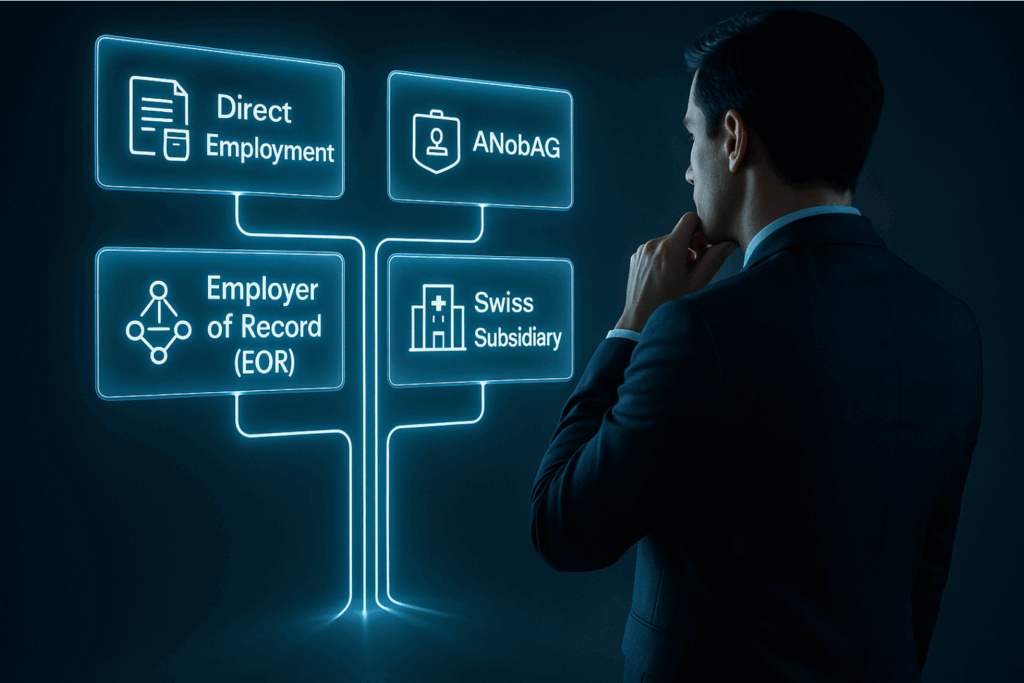
However, direct employment is not the only route available. If direct employment is either inapplicable or presents practical hurdles—such as administrative complexity, social security obligations, or tax uncertainty—other models may be more suitable. The following section introduces alternative approaches, such as Employer of Record (EOR) solutions and setting up a Swiss entity, and explains why ANobAG rarely applies with a UK employer.
Each has its own advantages and trade-offs, depending on the company’s long-term strategy, the employee’s permit, and the operational structure.
Direct UK Employment
- Eligibility: Suitable when the employer is based in Great Britain, Northern Ireland or Gibraltar, usually whatever the employee’s passport. This setup assumes a direct legal relationship between the UK employer and the Swiss-resident employee.
- Advantages: Clear rules under the UK-Swiss social security agreement allow straightforward application. This model replicates local employment standards without introducing a third party. It’s often preferred where a long-term or senior relationship is intended, such as for key staff.
- Considerations: The employer pays the Swiss contributions itself through a Swiss contact point, such as us, or agrees with the employee that they pay them on its behalf under an Art. 18 agreement (see the UK section of our guide). With no Swiss presence, no Swiss tax is withheld, but income taxation still needs to be assessed on a workday basis.
ANobAG: Usually Not With a UK Employer
- Eligibility: Usually not an option with a UK employer. Staff of UK employers who are insured in Switzerland aren’t ANobAG, usually whatever their passport: the employer owes Swiss contributions under the Switzerland-UK convention, as described above.
- Exception: Employers in Jersey, Guernsey or the Isle of Man still fall under the older 1968 convention, so their staff here are generally ANobAG. The employer then owes no Swiss contributions, and the employee pays all of them, with no employer share.
- Details: See the UK section and the ANobAG section of our guide.
Employer of Record (EOR) Services
- Eligibility: Works for companies of any size when setting up directly isn’t practical or time is limited, but only for hires who are already allowed to work in Switzerland and to change jobs. EU and EFTA nationals generally qualify; a new hire from elsewhere who still needs a permit generally doesn’t (see employer of record or direct hire).
- Advantages: The EOR model legally employs the individual in Switzerland on behalf of the UK business, ensuring full local compliance with social security, tax, and labor law obligations. It offers a plug-and-play solution for hiring in Switzerland with minimal internal resources.
- Considerations: The EOR is a third party in the employment chain. While practical, this can sometimes cause perception issues—especially if the employee holds a senior or client-facing role. Furthermore, long-term retention through EOR may become costly or complex.
Establishing a Swiss Subsidiary or Branch
- Eligibility: Best suited for companies with multiple employees in Switzerland or with plans to develop local operations.
- Advantages: A full Swiss legal presence allows direct employment under Swiss law, with full control over HR, payroll, and compliance. It also enables local invoicing and contracting, which can be strategically beneficial.
- Considerations: Setting up a Swiss entity involves initial legal, notarial, and capital expenses, as well as ongoing accounting, payroll, and compliance requirements. It’s a long-term commitment, not a quick fix.
Comparison Table: Employment Methods
| Method | Administrative Effort | Cost | Employer Responsibility | Suitable Scenario |
|---|---|---|---|---|
| Direct UK Employment | Moderate | Moderate | Coordinate Swiss social security & taxes | Long-term roles, usually any nationality |
| ANobAG | Low (for employer) | Low | Limited to salary payments & contracts | Only employers in Jersey, Guernsey or the Isle of Man |
| Employer of Record (EOR) | Minimal | Higher | Delegated to EOR provider | Quick setup, limited HR capacity; hires already allowed to work here |
| Swiss Subsidiary/Branch | High | Initially highest | Full local compliance & HR infrastructure | Multi-employee operations or strategic presence |
Conclusion
Hiring in Switzerland as a UK-based company can be highly rewarding but also complex. Switzerland provides access to a skilled, multilingual workforce, but it also has strict requirements for social security compliance, tax regulations, and employee protections. Each choice—whether it’s structuring employment or managing contributions—can greatly influence the company’s risk and the employee’s benefits.
Direct employment under the Switzerland-UK convention is usually open whatever the employee’s passport, but it needs a careful set-up from the first working day. Where it isn’t practical because of internal resources or administrative constraints, an employer of record can be a useful alternative for hires who are already allowed to work here. For companies planning a long-term presence or scaling their operations in Switzerland, establishing a local entity may be the most sustainable path.
Taxation, meanwhile, follows its own set of rules. Employers and employees must understand that no Swiss tax is withheld when the employer has no Swiss presence, and that income may be taxed in both the UK and Switzerland depending on where the work is performed. This makes accurate workday tracking and professional guidance essential.
If you’re considering hiring in Switzerland, we invite you to book a free discovery call with our team. In this initial conversation, we’ll help you assess which employment model is the best fit for your specific situation—whether it’s direct employment, an employer of record or a local entity. Our goal is to give you clarity, highlight risks, and offer a compliant path forward without any commitment required.
Taxolution Advisory LLC is a private advisory firm and is not affiliated with any government authority. You can also deal with your cantonal compensation office directly, without our fees: see the list of offices on ahv-iv.ch.
Need an employer of record instead? We also have Taxolution Payroll: for salaries from CHF 150,000, it employs your hire in Switzerland at a flat monthly fee.
Table of Contents
Related: Before setting up a Swiss entity, see our Swiss corporate tax guide for cantonal rate ranges, TRAF relief, Pillar Two scope and the choice between a GmbH and an AG.
Latest blog posts

International Work Arrangements in Switzerland: ANobAG, EU and UK Employers, and Swiss Entities (2026)
Living in Switzerland with an employer abroad, or hiring here without a Swiss entity? ANobAG, EU and UK routes, who pays the contributions, and our fees.


ANobAG vs Payroll Company
If you live in Switzerland and work for an employer who does not have a place of business in Switzerland, the employment relationship is subject to a number of peculiarities.
Hiring in Switzerland: What UK Businesses Need to Know
This guide explains how UK companies can legally and efficiently hire talent based in Switzerland under the new bilateral social security treaty, along with key tax considerations to keep in mind.