Swiss Tax Deductions 2026: Complete Guide for Expats
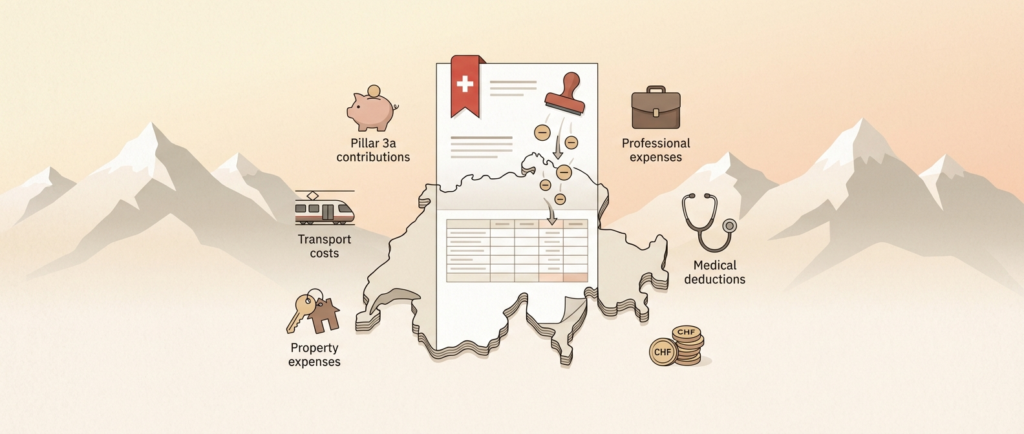
Swiss tax law lets you subtract a long list of items from gross income before the rate is applied: mandatory social contributions, Pillar 3a (up to CHF 7,258 in 2026), voluntary Pillar 2 buy-ins, professional expenses, property maintenance, insurance premiums, childcare up to CHF 25,800, alimony, charitable donations, and for temporary assignees, double-housing and relocation costs. The deductions stack at federal, cantonal, and communal level, and each layer has its own ceilings. For most employed expats, Pillar 3a and a Pillar 2 buy-in are the two deductions that move the needle; everything else trims the edges.
Key takeaways
- Pillar 3a cap for 2026: CHF 7,258 for employees with a Pillar 2, or 20% of net earned income up to CHF 36,288 for self-employed without a Pillar 2. A retroactive buy-in rule lets you close gaps in earlier years from 2025 onward.
- Pillar 2 voluntary buy-ins (Einkauf) are unlimited in principle, bounded only by your pension-fund statement’s “Einkaufspotenzial”. Lock-up: three years before any lump-sum withdrawal.
- Professional-expenses flat rate: 3% of net salary, minimum CHF 2,000, maximum CHF 4,000 federal. Commuting capped at CHF 3,300; car rate CHF 0.75/km.
- Insurance premium + savings interest (federal): CHF 3,700 married with Pillar 2/3a, CHF 1,800 single, CHF 700 per child.
- Canton choice changes deduction caps. Child deduction alone ranges from CHF 3,000 in Vaud to CHF 13,660 in Geneva per child.
- Rent is not deductible in 25 of 26 cantons. Zug is the single exception: 30% of rent up to CHF 10,800/year, ends when the Eigenmietwert is abolished in 2029. Personal living costs, commuting by car beyond the public-transport cost, and unrealised capital losses on private securities are also never deductible.
What Counts as a Swiss Tax Deduction in 2026
A Swiss tax deduction is anything that reduces your taxable income before the canton’s tariff schedule is applied. The federal direct-tax law (DBG, SR 642.11) groups them into three buckets. Professional expenses (Art. 26) cover the costs of earning your salary: commuting, lunch outside home, tools, and a 3% lump-sum for everything else. General deductions (Art. 33) cover items the federal parliament chose to subsidise for policy reasons: debt interest, Pillar 3a, insurance premiums, alimony, charitable donations, training. Social deductions (Art. 35) are per-person allowances for supporting a spouse, children, or dependents.
Cantonal income-tax laws mirror the federal structure under the Tax Harmonisation Act (StHG, SR 642.14), but each canton sets its own CHF amounts. A federal CHF 6,800 child deduction coexists with, for example, a ZH cantonal CHF 9,400 or a GE cantonal CHF 13,660. You claim the federal amount on your direct-federal-tax computation and the cantonal amount on the cantonal line. Both are in the same tax return.
How the Swiss Deduction Stack Works
Deductions apply to three tax layers: direct federal tax (IFD/DBSt), cantonal income tax, and communal income tax. Federal rules set federal CHF caps and the list of eligible items. Cantonal laws set cantonal CHF caps, which can be higher or lower than federal. The commune doesn’t set its own deduction rules; it applies a multiplier (“Steuerfuss”) to the cantonal base tax.
The election: flat-rate vs actual cost
For three of the big categories, Swiss law lets you pick flat-rate or actual cost each year, separately for federal and cantonal returns:
- Professional expenses: flat 3% (min CHF 2,000, max CHF 4,000 federal) or itemised costs with receipts.
- Property maintenance: flat 10% of imputed rental value if the building is 10 years old or younger, flat 20% if older, or itemised invoices (Liegenschaftskostenverordnung, SR 642.116, Art. 2).
- Sideline income: flat CHF 800 min / CHF 2,400 max, or itemised.
You pick the option that gives you the larger deduction. Swiss tax software calculates both and applies the better of the two automatically on most commercial filings. If your actual receipts beat the flat rate, keep the receipts and itemise.
Withholding tax (Quellensteuer) and deductions
If you’re taxed at source on a B permit below CHF 120,000 of gross annual income, most deductions are baked into your cantonal tariff and you don’t file a return. To claim Pillar 3a, Pillar 2 buy-ins, childcare over the cantonal flat, alimony paid, or medical costs, you file a “Nachträgliche ordentliche Veranlagung” (NOV) by the 31 March deadline after the tax year ends. Our withholding-tax guide and the NOV eligibility checker cover the mechanic.
How Deductions Actually Lower Your Tax Bill (Not Your Refund)
The single most common misconception: “I put CHF 7,258 into Pillar 3a, so I get CHF 7,258 back from the tax office.” That’s not how it works. A deduction reduces your taxable income, not your tax. The tax office then applies the tariff to the lower taxable income. Your saving equals the amount of the deduction times your marginal rate, the slope of the tax curve at your income level.
The stack, step by step
Take a single employee in Zurich earning a net salary of CHF 120,000 after mandatory social insurance (AHV, IV, EO, ALV, NBU, BVG). The 2026 stack on that salary:
- Net salary: CHF 120,000
- − Professional expenses lump sum (3% of net, ceiling CHF 4,000): CHF 4,000
- − Insurance premium + savings interest (single, with Pillar 2/3a): CHF 1,800
- = Taxable income before voluntary items: CHF 114,200
- − Pillar 3a contribution (if you make it): CHF 7,258
- − Other voluntary deductions (Pillar 2 buy-in, training, medical above 5%, charitable): variable
- = Final taxable income: the number the tariff is applied to
Without the Pillar 3a contribution, the tariff applied to CHF 114,200 produces a 2026 Zurich tax bill of CHF 20,121 (federal + cantonal + municipal, no church tax). Adding the full CHF 7,258 Pillar 3a contribution drops taxable income to CHF 106,942 and the tax bill to CHF 17,982: a saving of CHF 2,139, which is about 29.5% of the contribution. That CHF 2,139 is the “tax saving”. The remaining CHF 5,119 is not a cash loss — it’s money you moved from your current taxable account into your Pillar 3a account, still yours but locked until retirement with favourable withdrawal tax treatment on the way out.
Why the same deduction is worth more or less to different people
Two things swing the value of any Swiss deduction:
- Your income level. Swiss tax schedules are progressive. The higher your taxable income, the higher your marginal rate, the bigger the saving on the same CHF 7,258 contribution.
- Your canton and commune. At the same CHF 114,200 baseline taxable income, the same CHF 7,258 Pillar 3a contribution saves CHF 2,139 in Zurich, CHF 1,580 in Zug, and CHF 2,418 in Geneva. Geneva saves roughly 1.5× what Zug saves on the identical contribution, because Geneva’s marginal rate is about 33% vs Zug’s 22%.
A deduction’s tax-saving value equals amount × marginal rate. Its “effective cost” (cash out of your pocket today) equals amount − tax saved. For Pillar 3a that effective cost still ends up in your retirement account, so it’s not a true cost. For a one-time donation or a professional training course that you pay out-of-pocket, the effective cost is the net after-tax cash you actually part with.
Pick a canton, switch between Single and Family, and toggle Pillar 3a, medical, and training on and off to see the stack live:
Deduction Impact Estimator
Toggle Pillar 3a, medical, and training on and off to see how they reduce your taxable income — and your actual Swiss tax bill.
Tax saved from your selected voluntary deductions
CHF 0
Need help optimizing your Swiss tax situation?
Schedule a free consultationPillar 3a: The Largest Discretionary Deduction for Most Employed Residents
Pillar 3a (Säule 3a) is the single largest discretionary deduction available to most employed Swiss residents. Contributions are fully deductible from taxable income at federal, cantonal, and communal level under Art. 33 Abs. 1 Bst. e DBG and Art. 7 of the BVV 3 ordinance.
2026 contribution caps
- Employees with Pillar 2 coverage: CHF 7,258 per person per year.
- Self-employed without Pillar 2: 20% of net earned income, capped at CHF 36,288.
- Married couples: each spouse has a separate CHF 7,258 allowance, provided each has their own AHV-qualifying earned income.
The federal cap is set by the Federal Council in BVV 3 Art. 7 and updated each year to match the BVG “obere Limite” (CHF 90,720 for 2026). The CHF 7,258 figure is confirmed in the BSV “Beträge 2026” published 6 November 2025.
The new retroactive buy-in (since 2025)
An amendment to BVV 3 that entered into force 1 January 2025 now allows you to close past Pillar 3a gaps. If you had AHV-qualifying income in a year since 2025 but didn’t make the full Pillar 3a contribution, you can retroactively contribute up to the small-cap amount (CHF 7,258 in 2026) for any one earlier year within a rolling 10-year window. Three conditions: you must be AHV-liable in both the gap year and the buy-in year, you must make the current-year full contribution first, and the gap must have arisen from 2025 onward (earlier gaps are not eligible because the rule has no retroactivity into pre-2025 periods).
The first year in which a retroactive Pillar 3a buy-in is actually possible is 2026, for a 2025 gap. See our Pillar 3a guide for the full mechanic and the gap calculator.
How much does a Pillar 3a contribution actually save?
The tax saving equals your marginal rate times the contribution. At the CHF 114,200 single-household baseline used in the calculator above, the full CHF 7,258 contribution saves CHF 2,139 in Zurich, CHF 1,580 in Zug, and CHF 2,418 in Geneva — the canton spread reflects 22–34% marginal rates at that income level. The canton-comparison calculator runs the full Swiss-canton sweep for Pillar 3a specifically:
Pillar 3a Tax Savings Calculator
See how much you save on taxes each year by contributing to Pillar 3a.
Your estimated annual tax saving
CHF 0
Where your CHF 7,258 goes
How your canton compares (annual saving on max contribution)
Need help optimizing your Swiss tax situation?
Schedule a free consultationImportant caveat for US citizens and green-card holders
Pillar 3a is not a universal “max it out” recommendation. US citizens and US green-card holders resident in Switzerland face a different calculation: the Swiss deduction does not carry to a US tax return, and Swiss-registered investment funds held inside a Pillar 3a account are typically classified as PFICs for US purposes, which can trigger punitive US tax treatment and complex annual reporting. A bank-style 3a account (cash-savings form) is less exposed to the PFIC issue but still faces the mismatch that the contribution is not deductible on the US return and internal growth may be taxable year by year on the US side.
The same caution applies to Pillar 2 voluntary buy-ins (covered in the next section): the Swiss-tax benefit does not automatically net out on the US side, and the US treatment of Swiss second-pillar assets is more complex than the Swiss-only view suggests. Taxolution plans the Swiss side for US-citizen clients and coordinates with your US-side advisor; the Pillar 3a contribution and Pillar 2 buy-in decision should be taken together with that US advisor rather than on the Swiss-deduction view alone.
Pillar 2 Buy-Ins (Einkauf): The Biggest Single-Year Deduction Most People Miss
A voluntary purchase into your occupational pension fund (“Einkauf in die Pensionskasse”) is deductible without a CHF cap. The only limit is the “Einkaufspotenzial” printed on your pension-fund statement, which equals the maximum benefits you could theoretically have earned, minus what’s already in your account. People who arrived in Switzerland mid-career, went part-time for a few years, took an extended parental leave, or had a salary jump typically carry five- to six-figure Einkaufspotenzial for a decade after.
Three constraints matter:
- Foreign-resident limitation (Art. 60b BVV 2): new arrivals who have never been Swiss-insured can only buy in up to 20% of insured salary per year for the first five Swiss insurance years. After year five, the cap drops away.
- Three-year lock-up (Art. 79b BVG): once you buy in, you cannot withdraw the capital as a lump sum for three calendar years. A violation can trigger a back-assessment of the deduction. If you’re planning to retire and take a lump-sum, sequence the last buy-in at least three years before.
- Marginal-rate arbitrage: the value of the Einkauf depends on your current marginal rate minus the lump-sum withdrawal tax rate at retirement. The bigger the gap, the better the trade.
For a Zurich resident at a 30% marginal rate buying CHF 80,000 and withdrawing it as a lump sum later at roughly 7%, the net saving is 23 points of CHF 80,000 in present-value terms: roughly CHF 18,000 of permanent tax savings, on top of the investment return on the Einkauf inside the pension fund. Our Pillar 2 buy-in guide walks through the full optimisation, and the Pillar 2 buy-in calculator runs the differential against your canton, profile, and buy-in size.
Mandatory Social Insurance: What Comes Off Automatically
Before any voluntary deductions, Swiss law strips mandatory social insurance from your gross salary. Your employer handles these; you see them as line items on your payslip. They are deductible at federal and cantonal level under Art. 33 Abs. 1 Bst. d DBG.
- AHV / IV / EO (old-age, disability, loss-of-earnings): 5.30% of gross salary, employee share (total 10.60%, split 50/50 with employer). No salary cap; applies to CHF 1 through CHF 10 million alike.
- ALV (unemployment insurance): 1.10% of gross, employee share, on salary up to CHF 148,200. The 1% “solidarity” surcharge on salary above CHF 148,200 expired on 31 December 2022 and no longer applies; above the cap there is no ALV contribution. This is a common 2026-planning mistake; the SECO Faktenblatt confirms the expiry.
- NBU (non-occupational accident insurance): roughly 1–2% of insured salary up to CHF 148,200, set by the employer’s insurer. Occupational accident is paid by the employer; NBU is paid by the employee unless the employer elects otherwise.
- BVG (occupational pension, Pillar 2): mandatory above the entry threshold of CHF 22,680 annual salary. Your employee share is typically 6–12% of the coordinated salary (insurable range CHF 3,780 floor, CHF 90,720 upper limit, minus the CHF 26,460 coordination deduction), depending on age and plan.
Non-working residents pay a minimum AHV contribution of CHF 530 per year (obligatory) or CHF 1,010 for voluntary insurance. The old CHF 1,006 figure (still circulating in pre-2020 blog posts) is obsolete; current values are in the BSV Beträge 2026.
Professional Expenses: Commuting, Meals, and the Lump-Sum %
Professional expenses are governed by Art. 26 DBG and the EFD Berufskostenverordnung. Federal 2026 values were set by the ESTV Rundschreiben 2-215-D-2025 of 11 September 2025; cantonal amounts vary.
Commuting
The federal commuting deduction is capped at CHF 3,300 for 2026 (up from CHF 3,200 in 2025). You deduct either the annual cost of the public-transport subscription on your route, or, if public transport is impracticable, the car cost at CHF 0.75/km for the first 10,000 km and CHF 0.65/km above that, still capped at CHF 3,300. Bicycle and e-bike: flat CHF 700/year.
Cantons vary. Zurich caps at CHF 5,200, Bern at CHF 6,700. Geneva effectively doesn’t allow a commute deduction for trips inside its two-hour public-transport test radius (its cantonal flat is around CHF 534). Zug and Vaud let you claim actual cost without a fixed ceiling. If you live in a canton with a higher cap than federal, the federal line uses CHF 3,300, the cantonal line uses the canton’s figure.
Meals outside home
If work prevents you from eating at home at midday, you can deduct CHF 15 per day, capped at CHF 3,200 per year. If your employer subsidises meals (Lunchchecks, canteen), the deduction drops to CHF 7.50/day, CHF 1,600/year. Weekly stays away from your main residence get a larger allowance: CHF 30/day full or CHF 22.50 reduced, annual cap CHF 6,400 or CHF 4,800.
The “übrige Berufskosten” lump sum
For everything else (home-office share, tools, professional clothing, periodicals, a laptop you bought yourself, a union fee), federal law gives you a flat 3% of net salary, with a floor of CHF 2,000 and a ceiling of CHF 4,000. You can itemise if your actual costs beat the flat amount, but most expats at a salary above CHF 135,000 hit the CHF 4,000 ceiling with the flat rate and don’t need receipts.
Continuing education and professional training
Under Art. 33 Abs. 1 Bst. j DBG, “berufsorientierte Aus- und Weiterbildung” is deductible up to CHF 13,000 at federal level (canton varies). This covers degree programmes, certifications, language courses tied to your profession, and executive education. Employer-paid training you don’t reimburse isn’t deductible by you; if your employer invoices you and you pay in cash, you can deduct it. “Hobby” training (a photography course taken for personal interest) is not deductible.
Property Deductions: Maintenance, Mortgage Interest, Energy Costs
If you own Swiss property, the imputed rental value (Eigenmietwert) is added to your taxable income, and a bundle of property deductions is subtracted. The Swiss electorate voted on 28 September 2025 to abolish the Eigenmietwert with 57.7% “Yes”; the abolition is now confirmed for 1 January 2029 (Federal Council, April 2026 communiqué). For tax years 2026, 2027, and 2028 the current regime and all property deductions remain in force. When the reform comes into effect in 2029, mortgage-interest and maintenance deductions on a primary residence will be substantially restricted; our imputed rental value guide will cover the transition.
Maintenance: flat-rate or actual cost
Each year, for each Swiss property, you elect between a federal flat-rate (10% of gross Eigenmietwert if the building is 10 years old or younger, 20% otherwise; several cantons go higher) or actual documented costs. Only werterhaltend (value-preserving) costs count, value-adding improvements get capitalised and reduce the eventual Grundstückgewinnsteuer base when you sell. The 26-canton matrix, the wertvermehrend / werterhaltend boundary, the Dumont-practice repeal and the 2023 BGer “economic new build” abolition, and the bunching-vs-spreading strategy all sit in our Swiss property maintenance tax deductions guide.
Mortgage interest
Private debt interest, including mortgage interest on a Swiss residence, is deductible under Art. 33 Abs. 1 Bst. a DBG up to the aggregate ceiling of CHF 50,000 plus gross taxable investment income. For most owner-occupiers, the mortgage interest on one or two Swiss properties falls well inside this ceiling, so the cap rarely bites. It does bite on mixed-leverage portfolios where most of the gross investment return comes from exempt private capital gains.
Energy-efficiency and environmental deductions
Costs for energy-saving and environmental measures (heat-pump replacement, insulation, triple-glazing, solar installation, asbestos removal) are deductible under Art. 32 Abs. 2bis DBG and the Liegenschaftskostenverordnung Art. 1–3. Since 1 January 2020, costs that exceed the current year’s taxable income can be carried forward for up to two subsequent tax periods (three periods in total). The carry-forward is forfeited in any year you elect the flat-rate maintenance deduction, so plan the election carefully before a major energy retrofit. Cantons publish annual lists of qualifying measures; Zurich’s is in ZStB 30.4.
Our deeper piece on property maintenance cost optimisation walks through the annual election strategy.
Child, Family, and Spouse Deductions
Family deductions are where the federal-vs-cantonal split shows up most visibly. Federal law gives a child deduction of CHF 6,800 plus a Kinderabzug reduction of CHF 263 off the tax amount itself. Cantons add their own per-child deduction on top of that, and the canton-to-canton spread is roughly a factor of four: Vaud gives CHF 3,000 for the first child, Geneva gives CHF 13,660 per full dependent. For a family of two kids, canton choice alone is worth CHF 20,000+ of additional deduction between the extremes.
Childcare costs
Third-party childcare costs (Kita, Tagesmutter, after-school care) for children under 14 are deductible under Art. 33 Abs. 3 DBG up to CHF 25,800 per child federal, provided the cost is a direct consequence of both parents’ earned activity, education, or incapacity. Cantonal caps vary widely: Geneva matches federal at CHF 26,320, Zurich offers CHF 25,000, Basel-Stadt CHF 25,200, Bern CHF 12,000, Zug CHF 6,000 for external care (Zug lets you also deduct home-based care). Vaud: CHF 15,200.
Two-earner and married-couple deductions
Federal law gives married dual-income households two separate deductions stacked:
- Zweiverdienerabzug (Art. 33 Abs. 2 DBG): 50% of the lower earner’s net income, minimum CHF 8,600, maximum CHF 14,100. This offsets the stronger bracket creep that married couples face under joint taxation.
- Verheiratetenabzug (Art. 35 Abs. 1 Bst. c DBG): flat CHF 2,800 for all married couples, single or dual income.
The “marriage penalty” at federal level persists for some dual-high-earner couples. The pending individual-taxation reform, subject to a 2026 federal vote, would abolish joint taxation altogether. We track the reform in the individual-taxation brief.
Alimony and child support
Under Art. 33 Abs. 1 Bst. c DBG and Art. 23 Bst. f DBG, alimony (spousal maintenance) and periodic child-support payments to a separated or divorced partner are:
- Fully deductible for the payer, at federal and cantonal level.
- Fully taxable in the hands of the recipient.
One-time lump-sum settlements are neither deductible nor taxable; only periodic, enforceable-by-court payments qualify. Child-support payments are deductible only for minor children; once the child reaches 18, payments continue under civil law but the tax deduction for the payer ends and the taxability for the recipient also ends. Our divorce and tax guide covers the structuring.
Insurance Premiums, Medical Expenses, and Donations
Health and life insurance premiums
Under Art. 33 Abs. 1 Bst. g DBG, federal law caps the premium-plus-savings-interest deduction at:
- CHF 3,700 for married couples with Pillar 2 and Pillar 3a contributions.
- CHF 1,800 for singles with Pillar 2 and Pillar 3a contributions.
- CHF 5,550 / CHF 2,700 for married / single without Pillar 2 or 3a.
- CHF 700 per child and CHF 700 per dependent.
Most expats hit the ceiling on their mandatory KVG health-insurance premiums alone; life-insurance savings or non-mandatory health-riders only help if you’re already under the cap. Cantons add their own higher ceilings: Vaud goes to CHF 5,000/9,900 (single/married), Bern CHF 4,800/6,400, Geneva CHF 2,178/4,356 base plus a supplemental layer that can push significantly higher for heavy health-care users.
Medical and dental costs
Medical and dental costs are deductible under Art. 33 Abs. 1 Bst. h DBG to the extent they exceed 5% of net income at federal level. For a household with CHF 200,000 of net income, the first CHF 10,000 of out-of-pocket medical spend is not deductible; anything above is. Cantons often match 5%; Geneva is the outlier at 0.5%, which means Geneva residents can deduct almost all out-of-pocket medical spend.
Disability-related costs (“behinderungsbedingte Kosten”) under Art. 33 Abs. 1 Bst. hbis DBG have no income threshold; they are fully deductible from the first franc.
Charitable donations and political contributions
Donations to Swiss charitable organisations with tax-exempt status are deductible under Art. 33a DBG up to 20% of net income, minimum CHF 100. Foreign charities are not deductible unless they hold a specific cantonal recognition for reciprocal treatment.
Contributions to registered Swiss political parties are deductible up to CHF 10,600 federal under Art. 33 Abs. 1 Bst. i DBG.
Expat-Specific Deductions (ExpaV)
The Expatriates Ordinance (ExpaV, SR 642.118.3) creates an additional layer of deductions for a narrow group: employees on temporary assignment to Switzerland for no more than five years, employed by a foreign employer and posted to a Swiss group company, in an executive or specialist role. The 2016 revision of ExpaV tightened the scope, cutting self-employed, long-term residents, and simplified-procedure cases from eligibility.
Who qualifies
- “Leitende Angestellte” (executives) and “Spezialisten” with specific professional qualifications.
- Sent to Switzerland by a foreign employer, with a clear end date on the assignment (maximum 5 years).
- Intra-group transfer: the Swiss host and the foreign sending entity belong to the same corporate group.
- Continue to maintain a foreign residence (either you or your family uses it personally, not rented out).
What’s deductible
- Double housing: reasonable Swiss rent or accommodation cost while the foreign residence remains in your personal use.
- Relocation: necessary costs of moving to Switzerland and returning at the end of the assignment, directly tied to the posting.
- School fees: for dependent minor children attending a foreign-language private school, where public schools don’t teach in the child’s home language.
Individual items must be “angemessen” (reasonable) and documented. Instead of itemising housing and relocation, you can elect a flat CHF 1,500 per month under Art. 2 Abs. 3 ExpaV. School fees remain deductible on top of the flat rate. The CHF 1,500 figure has been stable since 2016 and is confirmed for 2026.
ExpaV is administered at cantonal level; each canton issues its own Merkblatt (Zurich ZStB 26.2, Bern Merkblatt 8). Our expat tax benefits guide covers the practical application and documentation requirements.
What You CAN’T Deduct in Switzerland
A short list of common misconceptions, mostly imported from US, UK, and EU tax habits:
- Rent for your main residence, in 25 of 26 cantons. Switzerland taxes home-ownership via the imputed rental value but does not let tenants deduct rent. Zug is the single exception: under § 33 Abs. 1 Ziff. 5 StG Zug, residents deduct 30% of their rent excluding ancillary costs, capped at CHF 10,800 per year from the 2025 tax period onward. The deduction applies to the self-occupied apartment at the Zug residence. It ends when the Eigenmietwert is abolished on 1 January 2029. No other canton offers a parallel rent deduction.
- Commuting by car beyond the public-transport alternative. If a train or bus can get you there in reasonable time, the car deduction is capped at the public-transport cost, not the actual car cost, subject to the CHF 3,300 federal ceiling.
- Personal living costs. Groceries, utilities for your main residence, furniture, clothing outside strictly professional requirements, streaming subscriptions, gym memberships.
- Unrealised capital losses on private securities. Private capital gains are tax-exempt; the flip side is that losses are not deductible either.
- Foreign real-estate maintenance. Because foreign rental income and imputed rental value are excluded from the Swiss tax base (only included for rate), the maintenance costs on the foreign property are also not deductible against Swiss income. Our worldwide income guide covers this asymmetry.
- Foreign charitable donations (no Swiss-cantonal recognition of the recipient).
- US-style mortgage-interest deductions on a second home abroad. Same worldwide-income mechanic: the foreign property is exempt-with-progression, so its interest is a foreign-return item.
- Hobby training. Only vocationally-oriented further education is deductible under Art. 33 Abs. 1 Bst. j DBG.
- Commuting for a non-compulsory second job once you’re already past the professional-expenses ceiling; the sideline flat (CHF 800–2,400) covers it.
FAQ: Swiss Tax Deductions 2026
How much is the Pillar 3a deduction in 2026?
CHF 7,258 for employees with Pillar 2 coverage; 20% of net earned income up to CHF 36,288 for self-employed without Pillar 2. Both spouses of a married couple can contribute their own CHF 7,258 if each has earned income.
Can I deduct rent in Switzerland?
In 25 of 26 cantons, no. Rent for your primary residence is a personal living cost, not a deductible item. The exception is Zug, which lets residents deduct 30% of their net rent (up to CHF 10,800/year) under § 33 Abs. 1 Ziff. 5 StG ZG — a cantonal counterweight to the Eigenmietwert burden that home-owners carry. The Zug rent deduction ends when the Eigenmietwert is abolished on 1 January 2029. Federal tax never recognises a rent deduction in any canton.
Are AHV and Pillar 2 contributions deductible?
Yes, fully. Mandatory AHV/IV/EO, ALV, NBU, and BVG employee contributions are all deductible under Art. 33 Abs. 1 Bst. d DBG. Voluntary Pillar 2 buy-ins are deductible without a fixed CHF cap, up to the Einkaufspotenzial on your pension-fund statement.
Is the professional-expenses lump sum 3% or an absolute number?
Both. It’s 3% of net salary, bounded by a CHF 2,000 floor and CHF 4,000 ceiling at federal level. At salaries above roughly CHF 135,000 the ceiling binds and you get the flat CHF 4,000 regardless of actual cost, unless you itemise a higher amount.
Do I still benefit from home-office deductions if I work remotely?
The “übrige Berufskosten” lump sum (CHF 2,000–4,000 federal) is meant to cover your home-office, tools, and professional equipment. You can itemise above that if your documented costs beat CHF 4,000, but most canton tax offices apply tight scrutiny to home-office deductions without a dedicated room. Some cantons (Bern, Zurich) publish specific Merkblätter on home-office deductibility.
I’m on a B permit below CHF 120,000 gross. How do I claim Pillar 3a and Pillar 2 buy-ins?
You file a “Nachträgliche ordentliche Veranlagung” (NOV) by 31 March after the tax year. Your employer withholds tax at source, which bakes in the flat cantonal deductions; NOV lets you claim the items that aren’t baked in: Pillar 3a, Pillar 2 buy-ins, childcare above the flat, alimony paid, medical costs above threshold, charitable donations, professional-training costs. Our NOV eligibility calculator covers when the filing is worth it.
Does the Eigenmietwert abolition affect my 2026 return?
No. The abolition vote passed on 28 September 2025, but it now takes effect on 1 January 2029 (Federal Council, April 2026 communiqué). For tax years 2026, 2027, and 2028 the imputed rental value is added to taxable income and the full set of property deductions (maintenance, mortgage interest, energy costs) remains available. For 2029 onward, mortgage-interest and maintenance deductions on a primary residence will be substantially restricted, so any property tax-planning you do in 2026–2027 should factor in the coming change.
I’m on a temporary assignment from my UK parent company for 3 years. Do I qualify for ExpaV?
Likely yes, if your role is executive or specialist, the assignment is formally limited to a period not exceeding 5 years, and you maintain a residence in the UK for personal use. You’d file Swiss tax at source initially, then file an NOV or ordinary return claiming ExpaV items (double housing or the CHF 1,500 flat, relocation, and school fees if applicable). The cantonal tax office may ask for the assignment letter and a copy of your UK residence proof.
What’s the easiest way to model my 2026 Swiss tax bill with deductions?
Use the tax-burden calculator for the canton-comparison view, the Pillar 3a savings calculator for the single-contribution impact, and the rate explorer for the marginal rate at your income level. All three use the 2026 federal and cantonal tariffs.
Plan the deductions before December 31
Pillar 3a, a Pillar 2 buy-in, childcare timing, canton choice, and ExpaV eligibility all need to be decided before the end of the tax year. A 30-minute Swiss-side review usually identifies CHF 3,000–15,000 of deductions most expats leave on the table. Taxolution plans the Swiss side; we coordinate with your US, UK, or EU advisor on the foreign side if needed.
Book a tax consultation →Table of Contents
Table of Contents
Latest blog posts
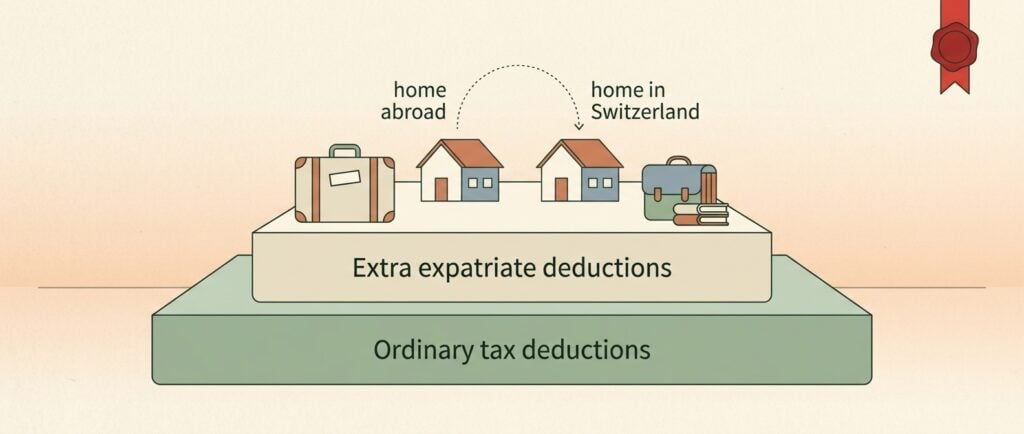
Swiss Expat Tax Benefits 2026: Special Tax Deductions for Posted Employees
In this article, we explain what the special “expat” status is all about, how an expat differs from other employees in Switzerland, and what benefits you can derive from it if you also belong to this group.

Is Switzerland Still a Tax Haven in 2026? How Much You Actually Pay vs the EU, UK, UAE & Monaco
Switzerland isn’t classically a tax haven, but for high earners the structural mix beats every EU comparator. Take-home and wealth tax compared to UAE, Monaco, UK, Germany, Italy, more.
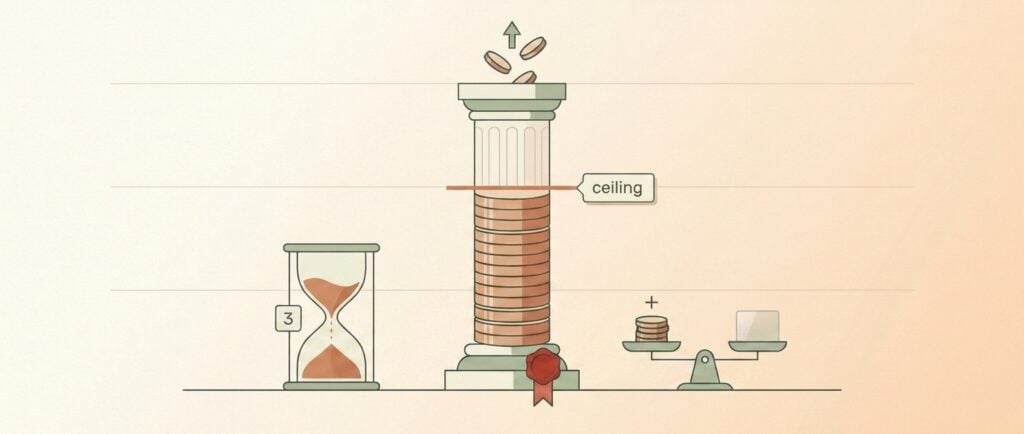
Swiss Pillar 2 Buy-In 2026: Tax Savings, the 3-Year Withdrawal Block, and When It’s Worth It
Many pension funds advertise voluntary purchases and present attractive calculation models to interested parties. What is often not mentioned is that the voluntary purchase into the pension fund is not worthwhile for everyone and does not always help with tax savings.