Swiss Property Maintenance Tax Deductions 2026: Last Window Before the 2029 Eigenmietwert Switch
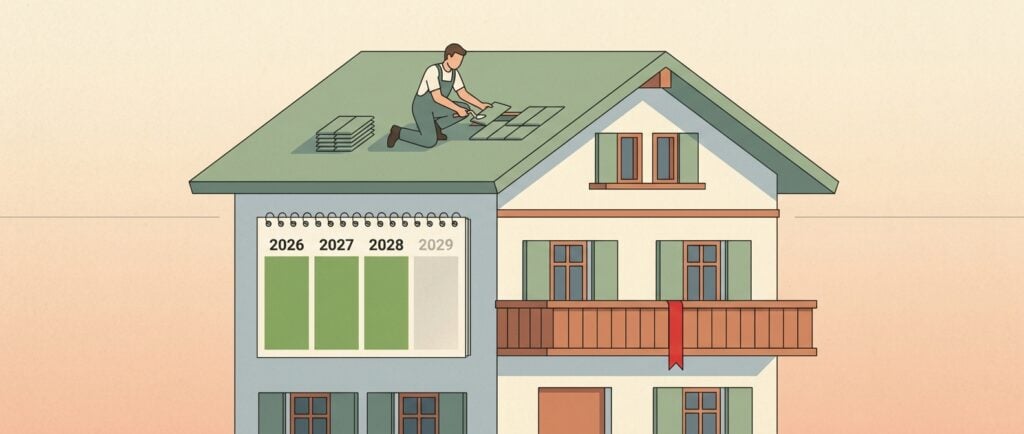
Swiss owner-occupiers can deduct property maintenance costs from taxable income at either a flat 20% of imputed rental value or the actual amount spent, whichever is higher, but only for three more tax years. The 28 September 2025 federal vote abolished the imputed rental value (the income tax Switzerland charges you for living in your own home, known in German as the Eigenmietwert) with effect 1 January 2029, and the federal maintenance deduction disappears alongside it. That leaves 2026, 2027 and 2028 as the last full windows where the existing planning levers still apply at the federal level: flat-rate vs effective costs, multi-year bunching, the energy-saving carve-out, and demolition costs in a teardown-and-rebuild project (Rückbaukosten on an Ersatzneubau). This Swiss tax deductions guide walks through the rules canton by canton, shows the actual tax-bill delta of each lever, and flags what changes after 2029.
Key takeaways
- The federal flat-rate is 10% of imputed rental value for properties up to 10 years old, 20% above that (federal direct-tax law DBG art. 32 abs. 4 and the federal property-cost ordinance LiegKV art. 5).
- The 28.9.2025 federal vote (57.7% yes, with 19 of 26 cantons in favour) ends the federal property-maintenance deduction on 1.1.2029. Tax years 2026, 2027 and 2028 are the last federal windows.
- Five cantons diverge from the federal default: Basel-Land 12% / 24%, Geneva 15% / 25%, Luzern three-tier 15% / 25% / 33⅓%, and Appenzell-Innerrhoden, St. Gallen, Vaud and Zürich all 20% flat regardless of property age.
- Timing matters and the right move depends on size. Bunch small or medium work into one year to activate the federal flat-rate floor in the other years; spread large work (above ~50% of annual taxable income) evenly to keep every franc of deduction in your top marginal bracket.
- Energy-saving renovations remain deductible until 2028 federally; cantons may keep the deduction until 2050 maximum. That is the only post-2029 carve-out.
Property Maintenance Deductions at a Glance (2026)
The four questions every Swiss homeowner asks, answered.
A federal income-tax deduction for value-preserving costs on private real estate. Choose the flat rate (20% of imputed rental value for properties >10y) or the actual amount spent, annually and per property.
Owner-occupiers and landlords of private-asset Swiss real estate. Excluded: properties used predominantly for commercial purposes by third parties, and any business-asset property.
Tax years 2026, 2027 and 2028, the last three windows before the federal abolition takes effect 1.1.2029. Cantonal-level deductions may continue post-2029 with a 2050 sunset.
For a CHF 30,000 maintenance spend over the three-year window (Zürich single, CHF 200,000 income), the deduction saves roughly CHF 10,000 in income tax versus taking only the federal flat rate. The interactive calculator below shows the saving for your specific canton, household, and project size.
How the Swiss property maintenance deduction works
Switzerland lets owner-occupiers and landlords deduct value-preserving costs on private real estate from their income tax. The deduction is set federally by the direct-tax law (DBG art. 32 abs. 4) and the federal property-cost ordinance (LiegKV, SR 642.116), then replicated by each canton’s tax law. Two methods exist for any tax year, the flat rate (Pauschalabzug) and the actual costs (effektive Kosten), and you choose the one that gives the bigger deduction. The choice is annual and per property.
That sounds simple. In practice, the choice interacts with property age, the canton’s flat-rate percentage, your marginal tax rate, and the size and timing of any project work. The federal scheme and the per-year switch are the two anchor rules.
The federal scheme: 10% / 20% by property age
The federal flat rate is 10% of imputed rental value for properties up to 10 years old and 20% for properties over 10 years (LiegKV art. 5 abs. 2). The threshold uses the property’s age “zu Beginn der Steuerperiode” (at the start of the tax period), measured from Bezugsbereitschaft (move-in readiness), not the year you bought it. For rented property, the same 10% / 20% applies, but to gross annual rent received instead of imputed rental value (Eigenmietwert).
The flat rate under LiegKV art. 5 abs. 1 replaces six categories at once: ordinary maintenance, restoration of newly-acquired properties, third-party management, energy-saving investments, demolition costs (Rückbaukosten) on a teardown-and-rebuild project (Ersatzneubau), and insurance premiums. You either take the flat rate against all six together, or you switch to actual costs against all six together. There is no à-la-carte mixing within a single property in a single year. If you’re buying property in Switzerland, this is the first lever you’ll meet on the Swiss tax return.
The annual switch right (Wechselpauschale)
You choose flat-rate or effective costs per tax year and per property, with no multi-year lock (LiegKV art. 5 abs. 4). Own two properties? In year 1 you can take the flat rate on the alpine chalet and effective on the city apartment, then swap in year 2. There is no commitment, no notification to the tax office in advance, and no penalty for moving back and forth. The decision lives inside the annual return.
This is the structural reason bunching works. Because the choice is annual, you can stage maintenance projects to land in years where effective costs cover them, and collect the flat rate as a guaranteed floor in the years between.
Which costs are value-preserving (deductible) and which aren’t
Only value-preserving costs (werterhaltend) are deductible. They maintain the property’s existing condition and function. Costs that improve the property (wertvermehrend) are not deductible against income tax; they are capitalised and reduce the eventual real-estate gains tax bill (Grundstückgewinnsteuer) when you sell. The line between the two categories is the most disputed question in Swiss property taxation, and the federal court rewrote part of it in 2023.
Value-preserving: the deductible side
Value-preserving costs are the ones that keep the property where it already is. Facade painting, roof repairs, like-for-like boiler or heat-pump replacement, window replacement at the same dimensions and quality, kitchen appliance replacement, regular service contracts, building insurance premiums, and renewal-fund contributions (Erneuerungsfonds-Einlagen) for condominium-owned units (Stockwerkeigentum, where the fund is restricted to common-parts maintenance) all sit on this side of the line.
Cantonal tax authorities publish item-lists that classify common renovations. Zürich’s catalogue (ZStB 30.3) is the most widely cited, and other cantons largely mirror it. When in doubt, that is the document tax officers reach for.
Value-enhancing: the capitalised side
Value-enhancing costs add something the property didn’t have before. Kitchen-layout extension, replacing carpet with marble flooring, adding a conservatory (Wintergarten), attic conversion to living space, balcony enlargement, swimming-pool installation. None of these reduce your income tax in the year of payment.
They do, however, survive. Value-enhancing costs feed the cost-base add-back (Anlagekosten) when you eventually sell, lowering your real-estate gains tax (Grundstückgewinnsteuer). Keep the invoices for two decades. The cantonal gains-tax authority will want to see them.
Mixed renovations: how the 2023 Federal Supreme Court ruling changed the rules
Most kitchen and bathroom renovations are partly value-preserving and partly value-enhancing. Cantonal practice splits the cost with standardised percentages, typically 50% to 70% deductible for a full kitchen renewal in an older property. The numbers vary by canton; the cantonal item-lists (Zürich’s ZStB 30.3 is the reference) set the rough range.
Until February 2023, the Federal Supreme Court (Bundesgericht, BGer) used an “economic-new-build” rule (wirtschaftlicher Neubau). If a gut renovation (Totalsanierung) exceeded the property’s pre-renovation value, the entire spend was treated as a new build and was wholly non-deductible against income tax. That rule is gone. In BGer 9C_677/2021 of 23 February 2023, the court held that the value-preserving / value-enhancing split must be assessed on objective-technical criteria, against the specific installation being maintained or replaced, not against the overall property value. The schematic refusal of every cost in a gut renovation no longer fits the federal direct-tax law (DBG art. 32 abs. 2).
The practical effect: each measure is now assessed on its own merits, against the specific installation it replaces. Even inside a gut renovation, the value-preserving portions stay deductible. On heavy projects, that opens up materially more deduction than the old rule allowed.
Pick a renovation item below to see the typical werterhaltend / wertvermehrend split, the energy-saving carve-out where it applies, and the deductible-vs-capitalised CHF breakdown.
Maintenance Cost Classifier
Pick a renovation item to see the typical werterhaltend (deductible) vs wertvermehrend (capitalised) split, energy-saving carve-out where it applies, and the deductible-vs-capitalised CHF breakdown.
Need help optimizing your Swiss tax situation?
Schedule a free consultationFlat rate vs effective costs: the annual decision
The flat rate vs effective decision is binary and reversible. Each year, on each property, you take whichever number is bigger. The flat rate (10% or 20% of imputed rental value) is automatic, requires no receipts, no documentation, and carries no audit risk on the deduction itself. Effective costs require invoices and bank records, but in any year of significant maintenance work the actual figure dwarfs the flat rate.
When the flat rate wins
On a CHF 18,000 imputed rental value, the federal flat rate is CHF 18,000 × 20% = CHF 3,600. If your year’s maintenance is CHF 1,500 (annual boiler service, gutter cleaning, paint touch-ups), the flat rate wins by CHF 2,100. You also avoid the receipt-keeping. Most years on a typical property look like this. The flat rate is the floor that pays you for doing nothing significant.
When effective costs win
Effective costs win in any year where actual maintenance is above 20% of imputed rental value. The trickier question is whether to bunch the work into one year or spread it evenly across the cycle, and the right answer depends on the size of the budget relative to your income. Two regimes apply.
Small or medium work, bunching wins. Take a Zürich single owner with net taxable income around CHF 200,000 (CHF 194,200 baseline plus CHF 18,000 of imputed rental value), property older than 10 years, planning CHF 30,000 of effective maintenance over three years. Spread strategy: CHF 10,000 effective each year, three-year tax bill CHF 148,242. Bunched strategy: front-load CHF 30,000 into year 1, take the federal flat rate of CHF 3,600 in years 2 and 3, three-year tax bill CHF 145,829 (Taxolution 2026 tax model, single filer, no church tax). Bunching saves CHF 2,413 over the cycle. The mechanic is the federal flat-rate floor: by bunching, you collect the full effective deduction in year 1 AND the guaranteed flat rate in the other two years; by spreading, the floor never activates because per-year effective always beats it. Bunching adds CHF 7,200 of “free” deduction across the cycle.
Large work, spreading wins. Same Zürich owner, same income, same property, but CHF 200,000 of work budgeted over three years (a major roof, full insulation upgrade, new kitchen, plus ongoing items). Spread strategy: CHF 66,667 effective each year against CHF 212,200 of taxable-with-property income, three-year tax bill CHF 88,169. Bunched strategy: CHF 200,000 in year 1 against CHF 212,200, dropping taxable to CHF 12,200; flat rate years 2 and 3, three-year tax bill CHF 104,053. Spreading saves CHF 15,884 over the cycle. The reason flips: at this budget size, the year-1 bunched deduction is so large that the bottom CHF 100,000 of it pushes your taxable income out of your top bracket and into much lower ones. Each franc of deduction is worth ~22% in those lower brackets instead of ~38% at the top. Spreading keeps every franc against your top marginal rate every year.
The crossover for a Zürich single at CHF 200,000 income lands around CHF 90,000 to CHF 100,000 of three-year budget. Below that threshold, bunch. Above it, spread. For a married CHF 350,000 family, the crossover sits closer to CHF 150,000 to CHF 200,000 because the higher income gives more headroom before deductions push out of the top bracket. Run your specific numbers below and watch where the calculator flips between “Bunching wins” and “Spreading wins” as you slide the budget.
Property Maintenance Deduction Planner
Compare spreading vs bunching for your 3-year maintenance budget. Smaller budgets favour bunching; larger budgets favour spreading because of progressive marginal rates. The calc detects the winner for your scenario.
Bunching wins
CHF 0
| Year | Spread evenly | Bunched in year 1 |
|---|
Need help optimizing your Swiss tax situation?
Schedule a free consultationCantonal flat-rate matrix: where the federal default doesn’t hold
Five Swiss cantons diverge from the federal 10% / 20% default. Basel-Land applies 12% / 24% (reduced from 25 / 30 in 2016). Geneva raised to 15% / 25% in tax year 2025 under a revision of its personal-income tax law (LIPP). Luzern is the only canton with a three-tier scheme: 15% (≤10 years), 25% (10-25 years), and 33⅓% (>25 years). And Appenzell-Innerrhoden, St. Gallen, Vaud, and Zürich all apply a flat 20% regardless of property age, picking the higher federal bracket and applying it uniformly.
The cantonal level is what matters. Cantonal income tax typically runs two to four times the federal direct tax bill, so a cantonal divergence moves the deduction more than a federal one does. The remaining cantons follow the federal default per their published Steuerbücher and ESTV Kantonsblätter.
| Canton | ≤10 years | >10 years | Notes |
|---|---|---|---|
| Federal | 10% | 20% | DBG art. 32 abs. 4 + LiegKV art. 5 |
| AI Appenzell-Innerrhoden | 20% | 20% | Flat regardless of age |
| AR Appenzell-Ausserrhoden | 10% | 20% | Federal default |
| AG Aargau | 10% | 20% | Federal default |
| BL Basel-Land | 12% | 24% | Reduced from 25 / 30 in 2016 |
| BS Basel-Stadt | 10% | 20% | Federal default; energetic renovations spread over 2 years |
| BE Bern | 10% | 20% | Federal default |
| FR Fribourg | 10% | 20% | Federal default |
| GE Genève | 15% | 25% | Raised effective tax year 2025 |
| GL Glarus | 10% | 20% | Federal default |
| GR Graubünden | 10% | 20% | Federal default |
| JU Jura | 10% | 20% | Federal default |
| LU Luzern | 15% | 25% (10-25y) / 33⅓% (>25y) | Three-tier (10y, 25y thresholds), only canton |
| NE Neuchâtel | 10% | 20% | Federal default |
| NW Nidwalden | 10% | 20% | Federal default |
| OW Obwalden | 10% | 20% | Federal default |
| SG St. Gallen | 20% | 20% | Flat regardless of age |
| SH Schaffhausen | 10% | 20% | Federal default |
| SZ Schwyz | 10% | 20% | Federal default |
| SO Solothurn | 10% | 20% | Federal default |
| TG Thurgau | 10% | 20% | Federal default |
| TI Ticino | 10% | 20% | Federal default; flat-rate excluded for predominantly commercial-rented |
| UR Uri | 10% | 20% | Federal default |
| VS Valais | 10% | 20% | Federal default |
| VD Vaud | 20% | 20% | Flat regardless of age |
| ZG Zug | 10% | 20% | Federal default |
| ZH Zürich | 20% | 20% | Flat regardless of age |
Luzern is the only three-tier canton
LU’s 33⅓% deduction on properties older than 25 years can swing the flat-rate-vs-effective decision dramatically for older homes. On a CHF 18,000 EMW property aged 30 years, the LU cantonal flat rate is CHF 6,000 against the federal default of CHF 3,600. Owners of older Luzern property should re-run their flat-vs-effective comparison against the cantonal number, not the federal one.
Why the cantonal divergence matters
The cantonal income tax bill is typically two to four times the federal direct tax bill, so a cantonal flat-rate divergence moves your actual tax saving by the same multiple. In Basel-Land on a property older than 10 years, the cantonal 24% flat against the federal 20% on CHF 18,000 EMW gives an extra CHF 720 of cantonal deduction. At a marginal cantonal rate of 12% to 15%, that is CHF 90 to CHF 110 of pure cantonal saving on top of the federal flat rate.
Small per year. It accumulates over the three remaining federal windows. And it stacks with whichever bunching pattern you run.
Multi-year timing: the lever that flips with size
The strongest tax-planning move on a Swiss property is timing the work to either activate the flat-rate floor (when work is small or medium) or stay inside your top marginal bracket (when work is large). The first regime favours bunching, the second favours spreading, and the crossover sits roughly where a year’s bunched effective deduction would push your taxable income through your top bracket and into lower ones.
When bunching wins: the five-year alternating cycle
On a Zürich property with CHF 18,000 imputed rental value and a CHF 30,000 maintenance budget over five years, alternating bunched-and-flat beats spread spending by roughly CHF 7,200 in cumulative deductions. Here is how you get there. The federal 20% flat rate is CHF 3,600 a year, your guaranteed floor.
Strategy A (steady): CHF 6,000 of effective work each year for five years. Each year the effective number (CHF 6,000) beats the flat rate (CHF 3,600), so you claim CHF 6,000 effective five times = CHF 30,000 in cumulative deductions. The flat-rate floor never activates.
Strategy B (alternating bunched): CHF 10,000 of effective work in years 1, 3 and 5. Nothing in years 2 and 4 beyond emergency items. In the bunched years you claim CHF 10,000 effective; in the empty years you claim the CHF 3,600 federal flat rate. Cumulative deductions: CHF 10,000 × 3 + CHF 3,600 × 2 = CHF 37,200. That is CHF 7,200 of additional deduction from the same CHF 30,000 of spend, purely because you let the floor activate twice. At a 35% blended marginal rate, that is roughly CHF 2,500 in tax saved across the cycle from the timing choice alone.
This works at typical maintenance scales. For larger renovations the math flips, see the next section.
When spreading wins: large work above the marginal-rate threshold
The bunching-wins case assumes the year-1 deduction stays inside your top marginal bracket. Once the bunched deduction is large enough to push your taxable income out of the top bracket and through the lower ones, you start losing high-rate value on the bottom slice of the deduction. That tips the math toward spreading.
Concrete example. Same Zürich single owner, taxable income CHF 200,000, plus CHF 18,000 imputed rental value, plans CHF 200,000 of work over three years (deep retrofit, full kitchen and bathroom, window upgrade, structural repairs). Spread strategy: CHF 66,667 effective each year, taxable drops to CHF 145,533 each year, three-year tax bill CHF 88,169. Bunched strategy: CHF 200,000 in year 1 drops taxable to CHF 12,200 (well below the federal exemption); flat rate years 2 and 3 puts taxable at CHF 208,600, three-year tax bill CHF 104,053. Spreading saves CHF 15,884 across the cycle (Taxolution 2026 tax model). At CHF 300,000 of work for a married CHF 350,000 family in Geneva, spreading saves CHF 13,835 versus bunching.
Rule of thumb: if your three-year budget exceeds roughly half your annual taxable income, spread. The exact crossover depends on your canton (Zug’s flatter tariff curve pushes bunching to win at higher budgets than Zürich or Geneva), your filing status, and your property age. The calculator above flips between “Bunching wins” and “Spreading wins” as you slide the budget, so you can find your specific crossover.
When timing is not the constraint
Bunching only works if you can defer the spending. Many maintenance items can’t be deferred safely. Boiler failures, roof leaks, and mould remediation are not on the bunching menu. Plan-bunchable items include facade refresh, kitchen appliance replacement, garden work, contracted maintenance services, scheduled paint cycles, and window replacement on a known service interval.
One side note worth flagging. Large bunched works can affect property insurance premium recalculation and, on Stockwerkeigentum buildings, can require general-meeting approval. Coordinate with the Verwaltung early. The deduction is worth more if it actually lands in the tax year you planned for.
Energy-saving renovations: the value-enhancing carve-out
Energy-saving and environmental-protection investments are the only category of value-enhancing costs that are fully deductible against income tax. The framework lives in DBG art. 32 abs. 2 second sentence and is operationalised by LiegKV art. 1. The deduction covers solar-panel installation, heat-pump replacement (oil or gas to heat pump), thermal insulation upgrades, triple-glazed window replacement (better than the existing standard), and similar measures designated by the EFD-and-UVEK Energiesparmassnahmen catalogue.
One important constraint. LiegKV art. 1 limits the carve-out to bestehende Gebäude, existing buildings. Energy investments inside a brand-new build remain Anlagekosten and are not deductible against income tax. The carve-out rewards retrofit, not specification. If you are planning a new build, model the energy spend as part of construction cost, not as a year-of-payment deduction.
The two-period carry-forward
Energy-saving investments and Ersatzneubau Rückbaukosten that exceed your taxable income in the year of payment can carry forward for two further tax periods (DBG art. 32 abs. 2bis and LiegKV art. 4). That is a total deduction window of three tax periods. Two constraints follow from LiegKV art. 4 and matter operationally.
First, the carry-forward kicks in only when the deduction pushes your Reineinkommen below zero. If your taxable income absorbs the full energy spend in the year of payment, nothing carries forward. Second, in any year where the carry-forward applies, you cannot also claim the Pauschalabzug for the same property (LiegKV art. 4 abs. 4). It is effective costs only. No double-dipping the flat-rate floor on top of the carry-forward.
Worked example. A CHF 80,000 heat-pump and insulation upgrade in 2026 against CHF 95,000 of taxable income: claim CHF 80,000 in 2026, taxable income drops to CHF 15,000, no carry-forward triggered because Reineinkommen stays positive. On a CHF 200,000 Ersatzneubau spend with the same income, Reineinkommen would go negative and the unused balance carries to 2027 and 2028. Run your own scenario in the imputed rental value abolition calculator →
What survives 2029: the 2050 sunset
Federal energy-saving deductions disappear on 1.1.2029 alongside the rest of the maintenance deduction. Cantons may retain the energy-saving deduction at cantonal level under their own law, but the federal reform package built in a 2050 sunset. By 2050, no canton will have the deduction. This is the single deduction that survives 2029 in any form.
Plan accordingly. If you can pull energy-saving spend forward into 2026, 2027 or 2028, you collect federal plus cantonal. From 2029, only cantonal where retained. By 2050, none.
Ersatzneubau: demolition costs deductible
Tearing down an old Swiss house and rebuilding in its place became materially more tax-efficient on 1.1.2020. The LiegKV total revision added demolition costs (Rückbaukosten) to the list of deductible maintenance costs via DBG art. 32 abs. 2 third sentence. The strict definition from LiegKV art. 2: dismantling installations, demolishing the pre-existing building, and removing and disposing of construction waste. Combined with the energy-investment two-period carry-forward, a teardown-and-rebuild (Ersatzneubau) project can practically eliminate federal direct tax for the project’s three peak tax periods.
What qualifies as Ersatzneubau
LiegKV art. 3 sets three uniform requirements: same parcel, equivalent residential or mixed-use purpose, reasonable timeframe between demolition and new build. Demolish a residential building and put up a commercial one? No Rückbaukosten deduction. Demolish residential and rebuild residential or mixed-use? Qualifies. The new-build construction itself remains Anlagekosten and is capitalised against future Grundstückgewinnsteuer.
The scope limit is sharp. LiegKV art. 2 abs. 2 excludes Altlastensanierung (contamination cleanup), Geländeverschiebungen (earthworks), Rodungen (tree clearing), Planierungsarbeiten (site levelling), and Aushubarbeiten (excavation) for the new build. Only the demolition and waste-removal portions are deductible. And the same taxpayer must do the new build (LiegKV art. 2 abs. 4). You can’t demolish and sell the cleared parcel.
The three-period tax effect
For most Ersatzneubau projects, Rückbaukosten plus energy-saving investments effectively eliminate federal direct tax for up to three tax periods (year of cost plus two carry-forward years). It’s a practical outcome, not a legal entitlement. You still pay if the costs don’t fully absorb your taxable income in the window.
Worked example. A CHF 80,000 demolition (Rückbau) and CHF 120,000 energy-saving installation in 2026, total CHF 200,000 deductible against income. Combined household taxable income across the three-period window: CHF 280,000. Net taxable across the window after deductions: CHF 80,000. The federal direct tax bill on a project family with that income profile drops by roughly CHF 18,000 to CHF 22,000 across the three years, before counting the cantonal layer. The cantonal layer typically doubles or triples that figure.
Special cases: Stockwerkeigentum, foreign property, rented out
Three special cases shift the standard maintenance deduction rules. Stockwerkeigentum (condominium ownership) deducts contributions to the Erneuerungsfonds. Foreign property follows the deductibility-at-Belegenheitsort principle. And rented-out property keeps the federal deduction even after 1.1.2029, because rental income remains taxable.
Renewal-fund contributions for condominium owners (Erneuerungsfonds for Stockwerkeigentum)
Owners of a Swiss condominium unit deduct their contributions to the Erneuerungsfonds (renewal fund) as Liegenschaftsunterhalt, provided the fund is structured as Sondervermögen of the STWE-community and used solely for maintenance of the common parts. The deduction is the contribution itself, in the year you make it. The fund’s later spending doesn’t generate a separate deduction, since the money already left your taxable income on the way in.
One flag for post-2029. On owner-occupied condominium units, renewal-fund contributions lose deductibility alongside the rest of the federal maintenance deduction. St. Gallen has already published the transition rule (St. Gallen cantonal tax administration, February 2026). For condominium units rented out, the deduction continues, since the rental income remains taxable. See also our guide to imputed rental value for the imputed-rental-value-on-condominium detail.
Foreign property: deduction at Belegenheitsort
Maintenance costs on a foreign property are deducted at the Belegenheitsort, the country where the property is located. Switzerland exempts foreign-property income with progression effect, so the maintenance deduction belongs to the foreign tax return, not the Swiss one. The Swiss return uses the foreign property only for the rate-determining mechanism (Befreiung mit Progressionsvorbehalt).
The progression effect itself does move your Swiss tax bill. Foreign maintenance costs change the foreign net rental figure that flows into the Swiss progression computation. Run the numbers in the foreign-property calculator at /tax-calculators/#foreign-property to see the actual rate-determining impact for your specific country mix.
Rented-out property: surviving 2029
Renting your Swiss property to a third party doesn’t change the maintenance deduction rules. You choose flat-rate (10% or 20% of gross rental income, not EMW) or effective costs, annually, per property. The single material difference: post-1.1.2029 the deduction continues for rented property because rental income remains taxable, while it disappears for owner-occupied.
One universal exclusion to flag. Properties used predominantly for commercial purposes by third parties lose the flat-rate option entirely. Only effective costs work for those (DBG art. 32 abs. 4 and LiegKV art. 5 abs. 3). Mixed-use buildings where the commercial share is below 50% typically keep the flat-rate option, but the cantonal threshold varies. Confirm with your cantonal tax administration before claiming.
The 2029 cliff: what changes after the Eigenmietwert vote
The Federal Council (Bundesrat) decided on 1 April 2026 to set the imputed rental value reform’s effective date to 1 January 2029, pushing back the speculated 2028 start to give cantons the two-year adjustment window required by the federal tax-harmonisation law (StHG). From 1.1.2029, owner-occupiers pay no income tax on imputed rental value and lose the federal property-maintenance deduction in the same package. Tax years 2026, 2027 and 2028 are the last full federal windows.
Vote result and timeline
The 28 September 2025 federal vote passed at 57.7% yes against 42.3% no, on a 49.5% turnout. The cantonal count (Stände) was 19 in favour against 6 against. The six no cantons were the French-speaking group (Geneva, Vaud, Jura, Fribourg, Neuchâtel) plus Basel-Stadt, the only German-speaking canton on the no side at roughly 53% rejection (Federal Chancellery final result). The Federal Council communiqué of 1 April 2026 fixed the effective date at 1.1.2029 (EFD reform package).
What survives at cantonal level
Cantons may retain a cantonal Eigenmietwert under their own law. If they do, cantonal-level maintenance deductions follow on the same legal hook. Energy-saving deductions may also be retained cantonally, but with a federal-imposed 2050 sunset that forces full harmonisation by then.
As of April 2026, no canton has formally announced retention. Most cantonal finance departments are still in consultation. Plan as if cantonal deductions also disappear, then take any cantonal retention as upside. The downside scenario is the full federal cliff with no cantonal cushion. The upside scenario is a partial cantonal regime in your specific canton. Don’t budget on the upside until your canton publishes.
The 2026-2028 planning playbook
With three federal tax years left on the deduction clock (2026, 2027, 2028), the planning calculus shifts from steady-state optimisation to compressed-window optimisation. Four moves are worth running before 2029.
Move 1: Pull energy-saving spend forward
Heat pump, insulation, solar panels. Federal plus cantonal deduction is available now. Post-2029, the federal layer goes; cantonal may go too (2050 max). The two-period carry-forward gives you three effective tax periods to absorb a large spend, even if it tips Reineinkommen negative in year one.
Move 2: Match the timing to the project size
For small or medium maintenance budgets, hit one of the three remaining years hard with bunched effective work and take the federal flat rate in the others. The flat-rate floor activates “for free” in the empty years. For large budgets above roughly half your annual taxable income, do the opposite: spread the work evenly across 2026, 2027 and 2028 so each year’s deduction stays inside your top marginal bracket. The calculator earlier in the post shows where your specific crossover sits.
Move 3: Run Ersatzneubau before 2029
Rückbaukosten plus energy-investment three-period carry-forward only works while the federal deduction exists. Planning a teardown? Make sure demolition is invoiced and paid in the 2026-2028 window so the three-period absorption straddles the cliff at most by one year. The deduction window for a 2028 teardown runs through 2030 under the carry-forward; for a 2027 teardown, through 2029. After that, the federal hook is gone.
Move 4: Plan around the cantonal divergence
If you have property choice across cantons, or are considering a move, the BL 12 / 24 vs ZH 20 / 20 vs LU 15 / 25 / 33⅓ split actually matters in the last three windows. Old property in Luzern catches the 33⅓% deduction. New property in Zürich gets 20% from day one rather than 10%. Match the cantonal flat-rate to the property’s age profile and your bunching plan.
How Taxolution helps with property maintenance planning
We model the Swiss-side flat-rate-vs-effective decision for your specific property and canton, find your bunching-vs-spreading crossover for the actual project size, and stress-test Ersatzneubau projects for the federal three-period absorption. With only tax years 2026, 2027 and 2028 left on the federal clock, decisions made now lock in three years of tax outcomes. Canton, property age, imputed rental value, and project mix all interact non-trivially with the marginal-rate stack.
In our experience, two self-inflicted losses recur. The first: owners spreading a small CHF 30,000 to CHF 60,000 of work evenly across the three remaining federal years, when bunching into one year would have activated the flat-rate floor for free in the other two. The second, the mirror image: owners bunching a large CHF 200,000 renovation into a single year, when spreading would have kept every franc inside the top marginal bracket and saved CHF 10,000 to CHF 16,000 in tax. The size of the work flips which mistake is the costly one. Need to model your specific scenario? Book a Swiss tax-planning consultation and we’ll run the actual numbers for your property, canton, and three-year project plan.
Frequently asked questions
Can I deduct property maintenance costs on my Swiss tax return after 2028?
Not at the federal level. The 28.9.2025 vote ends the federal property-maintenance deduction (Liegenschaftsunterhalt) on 1.1.2029 (Federal Council communiqué of 1.4.2026) for owner-occupied housing. Cantons may retain a cantonal-level deduction under their own law if they also retain a cantonal imputed rental value. As of April 2026 no canton has formally announced retention. Rented-out property keeps the deduction, because rental income remains taxable.
What’s the difference between the flat-rate and effective-cost methods?
The flat rate is a percentage of imputed rental value (10% federal for properties up to 10 years, 20% for older) you can claim without receipts. The effective-cost method requires invoices and bank records but lets you deduct the actual maintenance spent. You choose whichever gives the bigger deduction, per tax year and per property (LiegKV art. 5 abs. 4). There is no multi-year commitment.
Are kitchen renovations deductible?
Partly. Cantonal practice splits a full kitchen renewal into werterhaltend (deductible) and wertvermehrend (capitalised), with standardised percentages typically 50% to 70% deductible. Like-for-like appliance replacement is fully deductible; layout extension or upgrading from a basic kitchen to a premium one is capitalised. Since BGer 9C_677/2021 of 23.2.2023, even gut renovations get a per-measure assessment, and the value-preserving portions stay deductible.
Can I deduct my renewal-fund contributions in a Swiss condominium?
Yes, if the renewal fund (Erneuerungsfonds) is held as separate community property of the condominium owners (Stockwerkeigentum) and used solely for maintenance of the common parts. The deduction is the contribution itself, not the fund’s later spending. Post-1.1.2029, this deduction disappears for owner-occupied units alongside the rest of the maintenance deduction. St. Gallen has already published the transition rule (St. Gallen cantonal tax administration, February 2026).
What’s the deduction for properties I rent out to private tenants?
Same flat-rate-vs-effective choice as owner-occupied, but the percentage applies to gross annual rent received instead of imputed rental value. Properties used predominantly for commercial purposes by third parties lose the flat-rate option entirely (LiegKV art. 5 abs. 3) and only effective costs work. Mixed-use buildings with commercial share below 50% typically keep the flat-rate option, but confirm the cantonal threshold with your Steueramt before claiming.
Are solar panels and heat pumps deductible?
Yes, even though they typically increase property value. They fall under the energy-saving and environmental-protection carve-out (DBG art. 32 abs. 2 second sentence and LiegKV art. 1) and are fully deductible against income tax. If the cost exceeds taxable income in the year of payment and pushes Reineinkommen below zero, the unused balance carries forward for two further tax periods (LiegKV art. 4). One constraint: the carve-out applies only to existing buildings, not energy spend inside a brand-new construction.
Can I deduct maintenance on a property I own abroad?
Not on the Swiss return. The deduction belongs to the country where the property is located (Belegenheitsort principle). Switzerland exempts foreign-property income with progression effect (Befreiung mit Progressionsvorbehalt), so the maintenance flows through the foreign tax return. The progression effect itself does affect your Swiss tax bill. See the worldwide-income guide for the rate-determining mechanism.
Will cantons keep the maintenance deduction after 2029?
Possibly, but with a federal sunset. Cantons may retain a cantonal Eigenmietwert and the matching cantonal deductions under their own law. The energy-saving deduction has a federal-imposed 2050 sunset, so cantons must phase that out by then. As of April 2026, no canton has formally announced retention plans; most cantonal finance departments are still in consultation. Plan as if all deductions disappear, then take cantonal retention as upside if it materialises.
Plan the maintenance window before 2029.
We model the Swiss-side flat-rate vs effective decision for your property, canton, and three-year project plan, with actual Taxolution 2026 tax model figures. Tax years 2026, 2027 and 2028 are the last federal windows, and the bunching, energy, and Ersatzneubau levers all interact non-trivially.
Table of Contents
Latest blog posts
Swiss Expat Tax Benefits 2026: Special Tax Deductions for Posted Employees
In this article, we explain what the special “expat” status is all about, how an expat differs from other employees in Switzerland, and what benefits you can derive from it if you also belong to this group.


Is Switzerland Still a Tax Haven in 2026? How Much You Actually Pay vs the EU, UK, UAE & Monaco
Switzerland isn’t classically a tax haven, but for high earners the structural mix beats every EU comparator. Take-home and wealth tax compared to UAE, Monaco, UK, Germany, Italy, more.
Swiss Pillar 2 Buy-In 2026: Tax Savings, the 3-Year Withdrawal Block, and When It’s Worth It
Many pension funds advertise voluntary purchases and present attractive calculation models to interested parties. What is often not mentioned is that the voluntary purchase into the pension fund is not worthwhile for everyone and does not always help with tax savings.