Swiss Corporate Tax 2026: Canton Rates + GmbH vs AG Guide
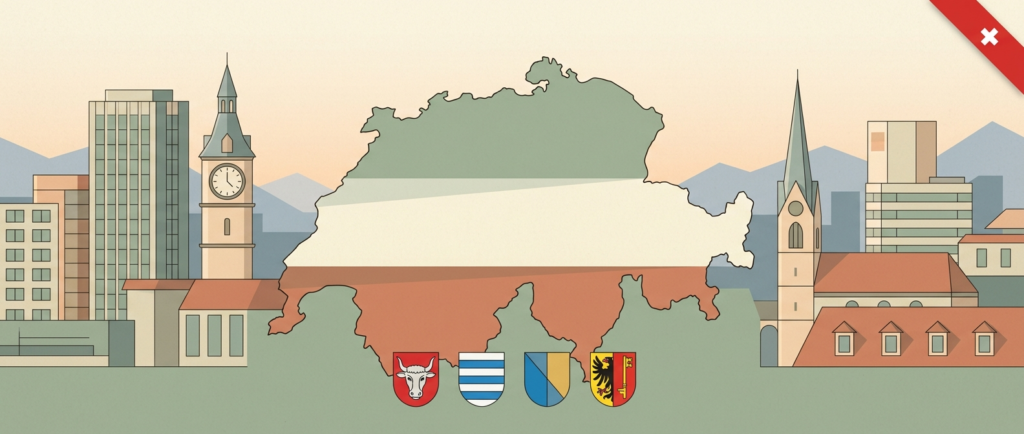
Switzerland’s headline federal corporate tax rate is 8.5%. The rate a founder actually pays ranges from 11.85% in Zug to 20.54% in Bern, depending on canton and commune. That nine-point spread is the whole story, and it is the part most “Swiss tax is low” summaries skip. This guide unpacks the federal + cantonal + communal stack for 2026, covers TRAF reliefs, GmbH versus AG, withholding tax on dividends, VAT, and owner-manager optimisation, and tells founders which decisions actually move the needle.
Key takeaways
- Effective combined corporate tax on pre-tax profit runs 11.85% in Zug to 20.54% in Bern for 2026 (KPMG Clarity on Swiss Taxes 2025). Ten cantons sit below 14%.
- Pillar Two’s 15% minimum applies only to groups above EUR 750 million consolidated revenue. Almost no Swiss SME is in scope.
- TRAF caps combined patent-box + R&D + NID relief at 70% of taxable profit per year (StHG Art. 25b).
- GmbH and AG are taxed identically. The real differences are capital (CHF 20k vs CHF 100k) and share mechanics.
- Safe-harbour interest on CHF shareholder loans drops to 0.75% for 2026 (FTA Circular 215).
Table of Contents
What is the effective corporate tax rate in Switzerland in 2026?
Swiss corporate tax is a three-layer stack: 8.5% federal direct tax on after-tax profit (which works out to roughly 7.83% on pre-tax profit, because the tax itself is deductible), plus a cantonal rate, plus a communal multiplier. For 2026, KPMG’s Clarity on Swiss Taxes 2025 puts the effective combined rate between 11.85% in Zug and 20.54% in Bern.
The federal layer is set by DBG Art. 68. It is flat, proportional, and applies to every AG and GmbH regardless of turnover. The effective 7.83% figure comes from the fact that the 8.5% is levied on profit after deducting the tax itself, so the real burden on pre-tax profit is a fraction of a point lower.
The cantonal layer sits on a harmonised base (StHG Art. 24) but each canton votes its own rate. On top of that, every commune applies an annual multiplier (Steuerfuss) to the cantonal base rate. The combined effective rate you see quoted for a canton is usually measured at the canton capital. Your specific commune may differ by half a point to one and a half points.
Why does this matter for a founder? Because “Swiss corporate tax” is famous for being low, but the reality is that the effective rate in Bern is in the same ballpark as Belgium’s or the Netherlands’ headline number. It is low in Zug, moderate in Geneva and Vaud, and middle-of-the-pack in Zurich and Bern. Where you seat your company determines which story you are in.
Effective corporate tax rate by canton 2026
Ten cantons most relevant to founders span a nine-point range in 2026: Zug leads at 11.85%, followed by Nidwalden at 11.97%, Lucerne at 12.15%, Uri at 12.64%, Schwyz at 14.06%, Vaud at about 14.0% (rising to 14.7% above CHF 10 million profit), Geneva at 14.70%, Ticino at 16.05%, Zurich at 19.61%, and Bern at 20.54%. Source: KPMG Clarity on Swiss Taxes 2025.
Swiss corporate tax rates by canton, 2026
Effective combined rate on pre-tax profit (federal + cantonal + communal, canton capital). Capital tax “credited” means the canton offsets profit tax against capital tax under StHG Art. 30.
| Canton | Effective profit tax | Capital tax credited? | R&D super-deduction | Patent box max |
|---|---|---|---|---|
| Zug (ZG) | 11.85% | No | Not adopted | 90% |
| Nidwalden (NW) | 11.97% | Yes | 50% | 90% |
| Lucerne (LU) | 12.15% | Yes | Limited | 10% (under review) |
| Uri (UR) | 12.64% | Yes | 50% | 90% |
| Schwyz (SZ) | 14.06% | Yes | 50% | 90% |
| Vaud (VD) | 14.00% / 14.70%* | Yes | 50% | 90% |
| Geneva (GE) | 14.70% | Partial | 50% | 90% |
| Ticino (TI) | 16.05% | Yes (16% credit from 2025) | 50% | 90% |
| Zurich (ZH) | 19.61% | Yes (full) | 50% | 90% |
| Bern (BE) | 20.54% | Yes | 50% | 90% (rarely used) |
*Vaud: 14.0% up to CHF 10m profit, 14.7% above. Source: KPMG Clarity on Swiss Taxes 2025, cross-verified against cantonal 2026 budget votes. Rates shown at canton capital; specific communes may differ by 0.5–1.5 points.
Central Switzerland (ZG, NW, LU, UR, SZ, OW) clusters at 12–14%. The Lake Geneva cantons (GE, VD) sit at 14–15%. Urban German-speaking cantons (ZH, BE, BS) land at 18–21%. The within-canton spread by commune is typically one to two points, so picking the right commune inside Zurich or Zug matters almost as much as picking the canton itself.
For a pure holding or a highly mobile tech business without strong local ties, ZG, NW, and LU are hard to beat on headline rate. For an operating company that depends on Zurich or Geneva talent, banking relationships, and international connectivity, the higher rate is often cheaper than the talent arbitrage of moving inland. The delta between Zug and Zurich on CHF 500,000 of profit is roughly CHF 39,000 a year, which is often less than one senior hire’s relocation cost.
Capital tax, the second corporate tax founders miss
Every Swiss canton levies a capital tax (Kapitalsteuer) on taxable equity, separate from the profit tax. Rates run from roughly 0.01% in some cantons on qualifying equity, up to about 0.5% on non-qualifying equity in others. Most cantons credit the profit tax against the capital tax under StHG Art. 30, so only the higher of the two actually bites. Zug notably does not credit, which makes it a real second tax there.
Taxable capital includes paid-in share capital, paid-in surplus booked as Kapitaleinlagereserven (KER), general reserves, and retained earnings. For a holding with CHF 50 million of equity in Geneva, the capital tax alone is around CHF 90,000 a year, even with zero profit. In Zurich, the same holding would likely owe nothing extra: the profit tax absorbs the capital-tax liability once the company is reasonably profitable.
The Zug exception matters most for high-capitalisation, low-profit structures. A seed-stage startup sitting on CHF 10 million of raised cash in Zug will pay its per-mille capital tax regardless of whether it earns a franc. The same company in Zurich pays only the higher of profit tax or capital tax, and capital tax typically falls away once real profit appears. Counterintuitively, for a pre-revenue company with a fat seed round, Zurich can be cheaper than Zug on the capital line.
Ticino added a 16% profit-tax credit against capital tax from tax year 2025 onward. A handful of cantons (Zug, Graubünden, Jura, Fribourg, Valais, Aargau) apply limited or no credit. For every other canton, the profit-tax credit makes capital tax a non-issue in any year the company is meaningfully profitable.
Practical move: always apply for the reduced rate on qualifying equity (StHG Art. 29a) if you hold participations of at least 10%, qualifying group loans, or patented IP. It is claimed in the cantonal tax return and reduces the rate on that slice of equity substantially.
TRAF 2020: patent box, R&D super-deduction, and the 70% cap
TRAF (Tax Reform and AHV Financing, in force since 1 January 2020) gave cantons three optional relief tools: a patent box worth up to 90% exemption on qualifying IP income (StHG Art. 24a), an R&D super-deduction up to 150% of qualifying Swiss R&D spend (Art. 25a), and a notional interest deduction available only in Zurich (Art. 25abis). Combined relief is capped at 70% of taxable profit per year (Art. 25b).
Patent box follows OECD BEPS Action 5 and applies only to registered IP — patents, supplementary protection certificates, topography rights, and, in narrow conditions in a few cantons, copyright-protected software. Qualifying income is multiplied by a nexus ratio (Swiss R&D over total R&D for the IP family) before the exemption. Most operating SMEs do not qualify; biotech, medtech, and hardware companies with registered IP do.
R&D super-deduction lets a canton grant up to 50% uplift on Swiss R&D personnel costs (grossed up by 35%) plus third-party Swiss R&D at 80%. Effective deductibility reaches 150% of direct R&D cost. Most cantons adopted the full 50% uplift. Zug, tellingly, declined the R&D super-deduction, betting that its low ordinary rate was enough.
The 70% cap (StHG Art. 25b) is mandatory everywhere and sequences as follows: sum the reliefs, compare to pre-relief profit, cap the reduction at 70%. A company with high qualifying IP income relative to ordinary profit can waste relief against the cap, so modelling the order of operations matters. One more catch: federal tax (the 8.5% on DBG Art. 68 profit) ignores TRAF reliefs entirely. The reliefs compress only the cantonal and communal stack.
Two operator notes. First, patent box entry is not a do-it-yourself move: get a ruling from the cantonal tax administration before the first claim, since the nexus calculation and documentation requirements vary by canton. Second, the transitional step-up regime for former status companies (holding, domicile, mixed) ended 2024/25; any company still carrying a legacy status structure now pays the ordinary rate with no transitional cushion, so review that now if it applies.
GmbH vs AG: what actually differs for tax purposes
For Swiss corporate tax purposes, GmbH and AG are treated identically. Same federal profit tax, same cantonal rates, same capital tax, same participation exemption, same TRAF reliefs, same withholding tax on dividends, same issue tax. The real differences are capital requirements, share mechanics, and shareholder visibility in the commercial register.
Minimum capital (post-2023 Code of Obligations revision): GmbH CHF 20,000, fully paid in at incorporation. AG CHF 100,000 nominal, with at least CHF 50,000 (or 20% of nominal, whichever is higher) paid in. Since the 2023 revision, both forms can denominate share capital in USD, EUR, GBP, or JPY, and both can use the new capital-band mechanism (AG only) or virtual general meetings.
Share and quota mechanics differ more than the tax math. AG shares transfer by endorsement, no notarial deed needed, and shareholders do not appear in the public commercial register. GmbH quota transfers require notarisation and a shareholder-meeting resolution, and every quota-holder is listed publicly. For a bootstrapped solo founder, the GmbH’s lower capital is the decisive factor. For a company planning VC funding rounds, employee share plans, or a secondary market for its shares, the AG’s cleaner share mechanics win.
Conversion GmbH to AG is tax-neutral under FusG Art. 53 and DBG Art. 61, as long as book values are preserved. FTA Circular No. 5 governs the mechanics. The standard path is: bootstrap as a GmbH with CHF 20,000, build retained earnings, convert to an AG before a first external round. The capitalisation of retained earnings into share capital at conversion uses part of the CHF 1 million issue-tax lifetime exemption, so plan the sequence.
For a founder ready to pick a form and move, the Swiss company incorporation process walks through the notary, bank capital-deposit confirmation, and commercial-register steps end-to-end. The tax math below is identical in either form, but the canton is not. Use our aggregate tax burden calculator to compare cantons at your expected profit level.
Swiss Tax Burden by Canton
Total effective tax rate (federal + cantonal + municipal), 2025 rates. Switch between income and wealth tax.
Total effective income tax rate (federal + cantonal + municipal), 2025 rates
Need help optimizing your Swiss tax situation?
Schedule a free consultationParticipation exemption on dividends (Beteiligungsabzug)
Swiss holding companies receiving dividends from qualifying subsidiaries benefit from the participation deduction under DBG Arts. 69–70. The relief approximates a full exemption on qualifying dividend income at the federal level, and all cantons mirror it under StHG Art. 28. The threshold is at least 10% of the subsidiary’s equity capital, or a fair market value of at least CHF 1 million in the holding.
Mechanically, the relief is not a rate cut. It is a ratio: net qualifying participation income divided by total taxable profit, multiplied by the tax otherwise due. Financing and administration costs attributable to the participation reduce the net qualifying income, so understating those costs overstates the relief. The cantonal and federal forms have a dedicated Beteiligungsabzug schedule.
Qualifying capital gains on a ≥10% participation get the same treatment, with two extra conditions: the shares sold must represent at least 10% of the subsidiary’s equity (no slicing below the threshold before a sale), and the position must have been held for at least one year. Fail any of the three tests and the capital gain falls out of the exemption. For sales structured as partial disposals, plan the tranches carefully.
The trap founders most often miss is the loss-carryforward interaction. If a holding has a CHF 200,000 loss carryforward and receives a CHF 500,000 qualifying dividend, statute requires the loss to be offset against total taxable income before the participation deduction is computed. Only the net CHF 300,000 enjoys the exemption. The CHF 200,000 absorbed against the loss is taxed at full corporate rates. For a Zug holding that means roughly CHF 15,660 of avoidable federal tax drag. Don’t stream dividends through a loss-carrying holding if you can help it; resolve the loss position first.
At the private shareholder level (owner-manager with a ≥10% stake), dividends qualify for partial taxation. Federal taxable base is 70% of the gross dividend (30% tax-free). Cantonal taxable base runs from the StHG minimum of 50% (ZG, SZ, NW, OW, ZH, BE, BS, SO, AG) up to 70% (GE, VD, TI, FR). The combined effective dividend tax rate for a top-bracket private shareholder typically lands in the 20–28% range, depending on canton.
Withholding tax on dividends: 35% gross, and how refunds work
Swiss withholding tax (Verrechnungssteuer) on dividends is 35% gross, set by VStG Art. 13. A Swiss GmbH or AG distributing a CHF 100,000 dividend must withhold CHF 35,000 and remit it to the ESTV within 30 days. Swiss-resident recipients reclaim it on their annual tax return. Foreign recipients recover the treaty rate through a double-tax-agreement refund claim, or avoid the cash withholding entirely through the notification procedure (Forms 106/108 domestically, Forms 823/823B/823C cross-border).
Two thresholds shifted on 1 January 2023 and still catch legacy documentation off-guard. The domestic intra-group notification threshold dropped from 20% to 10% (VStV Art. 24), so a Swiss parent holding 11% of a Swiss subsidiary now qualifies for Form 106. The validity period of cross-border permits (Forms 823/823B/823C) extended from three to five years. Both changes reduce friction for cleanly structured groups.
Key residual rates under major DTAs for qualifying participations (typically ≥10% or ≥25%, held 12 months, depending on treaty): Germany 5%, USA 5%, Singapore 5%, UAE 5%. United Kingdom, Netherlands, France, and Luxembourg go to 0% for qualifying participations and 15% for portfolio investors. Payments to an EU parent meeting the Swiss–EU Savings Agreement conditions (at least 25% participation held at least two years) go to 0% at source.
Three hard deadlines make or break the refund workflow. First, Form 106 must be filed within 30 days of the distribution resolution. Miss it and the full 35% is due in cash; the parent then reclaims, and cash is out of the group for six to twelve months. Second, cross-border Forms 823/823B/823C permits must be granted before the first distribution, not after. Third, refund claims (domestic or treaty) lapse three years after the end of the calendar year in which the dividend fell due. The three-year bar is strict.
This section covers the corporate distribution side of withholding tax. For the personal tax-at-source side (the Quellensteuer on employment income for non-permit-C residents), see our guide to Swiss withholding tax for individuals, which handles NOV eligibility, tariffs, and refund mechanics for employees.
VAT 2026: registration threshold, rates, and platform taxation
Swiss VAT in 2026 runs at 8.1% standard, 2.6% reduced (food, non-alcoholic beverages, books, newspapers, medicines), and 3.8% accommodation (hotels and short-term lodging). The rates were raised 1 January 2024 from 7.7%, 2.5%, and 3.7% respectively to finance AHV reform, and have been flat since. Mandatory registration kicks in at CHF 100,000 of worldwide taxable turnover.
Who actually has to register? The CHF 100,000 threshold is the most commonly missed detail for inbound founders. It is worldwide taxable turnover, not Swiss turnover. A Swiss GmbH billing CHF 60,000 domestically and CHF 60,000 abroad has crossed the threshold and must register within 30 days. Voluntary registration below CHF 100,000 is possible under MWSTG Art. 11, with a minimum one-year commitment, and makes sense in a heavy investment phase when input VAT recovery is valuable.
Two changes took effect 1 January 2025 and now anchor SME VAT practice. First, annual filing became available to businesses with turnover up to CHF 5,005,000; quarterly advance payments still apply based on the prior year’s liability, but the full reconciliation lands once a year. Second, platform operators (Amazon, Galaxus, and similar marketplaces) became the VAT-liable party on third-party sales of goods, under MWSTG Art. 20a. Sellers on those platforms now receive payment net of VAT and the platform remits to the ESTV.
A proposed extension of platform taxation to digital and electronic services (software, SaaS, streaming) went through Federal Council consultation that closed on 19 March 2026. No draft bill has yet reached parliament. Earliest possible entry into force is 2027. If you sell digital services through a marketplace, keep an eye on this one, but nothing changes for 2026.
Filing is electronic only via the ESTV ePortal since 1 January 2025. Paper returns are no longer accepted. Input VAT is fully deductible for taxable supplies; mixed activity (taxable plus exempt, e.g., a holding receiving exempt dividends alongside consulting income) requires apportionment, which is where most audit adjustments happen.
Owner-manager optimisation: salary, dividend, and the Capital Contribution Principle
Owner-managers of Swiss companies have three levers: salary (AHV-subject, fully deductible at corporate level, 100% personal income tax), dividend (no AHV, double-taxed at corporate then personal level with partial taxation at the shareholder level), and Capital Contribution Principle repayments (zero personal tax and zero withholding tax on qualifying equity contributions, provided Form 170 was filed with the ESTV in time). The optimal blend differs by canton.
The FTA requires a “reasonable” market-rate salary before dividends can be distributed. Benchmarks come from the Federal Statistical Office’s Salarium tool and the cantonal Ausgleichskasse tables. A mid-career professional in an SME with sole-client revenue cannot pay themselves CHF 30,000 and distribute CHF 200,000 as dividend. The SVA reclassifies part of the dividend as salary and back-assesses AHV, IV, EO, ALV, and BVG for up to five years, with interest.
The Capital Contribution Principle (KER / Kapitaleinlageprinzip) is the single most underused founder tool. Any paid-in surplus (agio) above share par value can later be repaid to shareholders tax-free, if it is booked to the “Reserven aus Kapitaleinlagen” line on the statutory balance sheet at the time of contribution and reported to the ESTV on Form 170 within 30 days. Miss either step and the agio becomes ordinary taxable reserves forever. A Federal Supreme Court ruling in 2025 confirmed that late or missing Form 170 is fatal even if the substance is intact.
Safe-harbour interest rates on intra-group loans shift annually. For 2026, FTA Circular 215 sets the minimum rate on a CHF shareholder loan at 0.75% (equity-financed), down from 1.00% in 2025, reflecting the SNB’s return to near-zero policy. Foreign-currency minima (Circular 216) for 2026 include EUR 3.00%, USD 4.50%, and GBP 4.75%. A loan priced below the safe harbour triggers a hidden-distribution adjustment with 35% withholding plus personal tax on the imputed interest. Review every intra-group loan contract in January when the new circular publishes.
Rule of thumb after TRAF: in low-tax cantons (ZG, SZ, NW), tilt extraction toward dividends once salary covers a market-rate floor (roughly CHF 90,000–120,000 for an SME owner-manager). In high-tax cantons (GE, VD, BS), a more balanced split around 60/40 salary-to-dividend typically wins, because the salary deduction is worth more against the higher corporate rate. In our client work, the single most common self-inflicted wound we see is owner-managers over-paying AHV on salary they could have distributed as dividend once the reasonable-salary floor was met, or flipping to all-dividend in Geneva and losing more to corporate tax than they saved in AHV. Founders who become Swiss-resident should read this alongside our guide to Swiss taxation of worldwide income, since personal residency flips which rules apply to you. For the specific split at your canton, profit level, and AHV history, book a Swiss tax-planning consultation.
A founder-specific aside on the personal side: individuals who hold their equity through a Swiss holding while taking no Swiss operating salary, and who are foreign nationals taking up Swiss residence for the first time, may qualify for personal lump-sum taxation. The regime replaces Swiss worldwide assessment with tax on a deemed expenditure base. See our Swiss lump-sum taxation guide for the four eligibility gates. Eligibility is narrow (no Swiss gainful activity, no Swiss citizenship, first Swiss residency) but can compound with canton-of-incorporation savings at the corporate level.
For founders relocating to Switzerland alongside their company, the residency, tax-at-source, and permit mechanics matter as much as the corporate setup. Our moving to Switzerland guide covers the personal side.
Frequently asked questions
What is the lowest corporate tax rate in Switzerland in 2026?
Zug at 11.85% effective combined, followed by Nidwalden at 11.97% and Lucerne at 12.15% (KPMG Clarity on Swiss Taxes 2025). Zug cut its cantonal multiplier from 82% to 78% for 2026–2029, which may pull the effective rate further below 11.85% once final communal numbers settle.
Do GmbH and AG pay different corporate taxes?
No. Federal direct tax, cantonal and communal profit tax, capital tax, participation exemption, issue tax, and withholding tax are identical for both forms. The choice between GmbH and AG is driven by capital (CHF 20,000 vs CHF 100,000), share mechanics (notarised quota transfers vs endorsement), and shareholder visibility in the public commercial register.
When does a Swiss company have to register for VAT?
When worldwide taxable turnover exceeds CHF 100,000 in a calendar year. Registration must happen within 30 days of crossing the threshold, and it is worldwide turnover, not Swiss-only. Voluntary registration below the threshold is available under MWSTG Art. 11 with a one-year minimum, and often makes sense during heavy investment phases for input VAT recovery.
Does Pillar Two affect my Swiss SME?
Almost certainly not. Pillar Two’s 15% minimum tax applies to multinational groups with consolidated revenue above EUR 750 million in at least two of the four preceding fiscal years. Swiss SMEs and essentially every stand-alone company fall outside scope. Document the revenue test in your tax file if it’s ever close, and move on.
How do foreign parent companies recover Swiss withholding tax on dividends?
Either through a DTA refund claim on the treaty form (Form 85 for Germany, Form 25 for the US, Form 86 for the UK), or by obtaining an advance notification permit (Forms 823/823B/823C) before the first distribution, which applies the treaty-reduced rate at source. The cross-border permit is now valid five years. Refund claims must be filed within three years.
Can I get a tax ruling before executing a Swiss corporate structure?
Yes for many planning situations: patent-box qualification, tax-neutral reorganisations under FusG, employee share-plan valuations, intra-group financing, and cross-border restructurings. No for black-letter rates (VAT rates, the 35% withholding tax gross rate, the 8.5% federal direct tax rate). If your strategy depends on a cantonal relief, get the ruling before you execute; cantons usually respond within four to eight weeks.
What to do next in 2026
Switzerland’s 8.5% federal rate is real but only the first of three layers. The effective combined rate for 2026 runs from 11.85% in Zug to 20.54% in Bern. Ten cantons sit below 14%, and within each canton the commune can swing the number by a further point or two. For most founders the canton choice does most of the work; the entity form (GmbH or AG) does almost none of the tax work, and the famous “Swiss holding” structure is now the participation exemption applied to any company that qualifies.
The levers that most founders under-use: the Capital Contribution Principle (Form 170 filed correctly from day one, so you can later repay equity tax-free), the R&D super-deduction (claimed in the return without a ruling, available from the first franc of Swiss R&D), and the participation exemption for dividends from qualifying subsidiaries. Pillar Two is a multinational rule masquerading as a corporate tax rule; if your group sits below EUR 750 million consolidated revenue, it is not your problem.
Every one of these decisions has second-order effects: canton choice reshapes salary-versus-dividend math, TRAF reliefs interact with Pillar Two for in-scope groups, loss carryforwards can sabotage the participation exemption. If you are setting up a Swiss entity or restructuring an existing one, book a Swiss tax-planning consultation to run the specific numbers for your profit profile, canton, and shareholder situation. Our full library of Swiss tax calculators covers the personal-side math for owner-managers drawing salary and dividends.
Incorporate, stay clean, optimise.
We help founders choose the right canton and structure, set up clean statutory accounts from day one, and optimise the ongoing tax position as the business grows.
Latest blog posts
Swiss Expat Tax Benefits 2026: Special Tax Deductions for Posted Employees
In this article, we explain what the special “expat” status is all about, how an expat differs from other employees in Switzerland, and what benefits you can derive from it if you also belong to this group.

Is Switzerland Still a Tax Haven in 2026? How Much You Actually Pay vs the EU, UK, UAE & Monaco
Switzerland isn’t classically a tax haven, but for high earners the structural mix beats every EU comparator. Take-home and wealth tax compared to UAE, Monaco, UK, Germany, Italy, more.
Swiss Pillar 2 Buy-In 2026: Tax Savings, the 3-Year Withdrawal Block, and When It’s Worth It
Many pension funds advertise voluntary purchases and present attractive calculation models to interested parties. What is often not mentioned is that the voluntary purchase into the pension fund is not worthwhile for everyone and does not always help with tax savings.