Swiss Pillar 2 Buy-In 2026: Tax Savings, the 3-Year Withdrawal Block, and When It’s Worth It
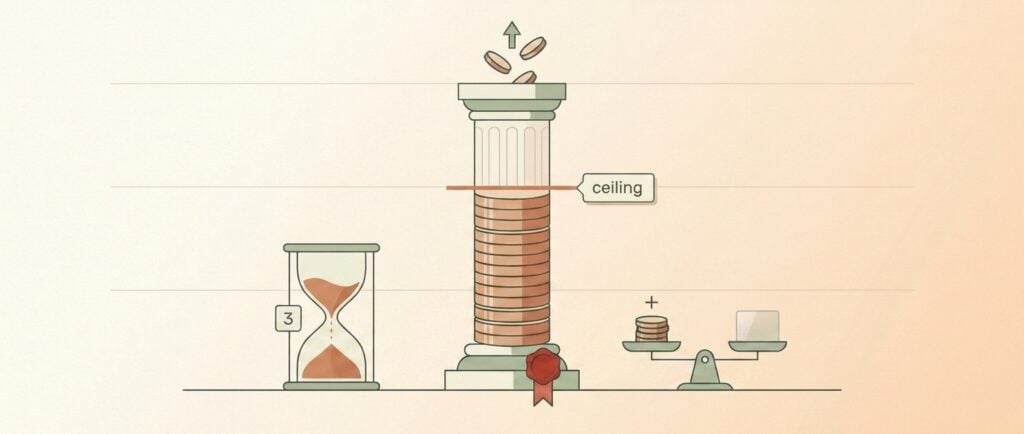
A voluntary buy-in into your Swiss Pillar 2 (Einkauf in die Pensionskasse) is a one-off payment that tops up your employer pension fund to its regulatory ceiling. The whole payment comes off your taxable income at federal, cantonal, and communal level. In exchange for that deduction, the buy-in capital is locked from any lump-sum withdrawal for three calendar years. (Federal direct tax: Art. 33 Abs. 1 lit. d DBG, mirrored at cantonal level by Art. 9 Abs. 2 lit. d StHG. The 3-year lock: Art. 79b Abs. 3 BVG.) Get the timing right and a CHF 100,000 buy-in saves about CHF 19,800 in Zug Stadt or CHF 37,400 in Lausanne at a CHF 250,000 single income, a CHF 17,500 spread on the same financial decision driven entirely by canton-of-residence. Get the timing wrong and the deduction is denied retroactively, across all your pension funds, not just the one you bought into. This guide walks through the 2026 mechanic, the five eligibility gates, the federal-court jurisprudence on Einkauf-then-withdrawal abuse, and the canton-by-canton numbers for the typical CHF 50,000–150,000 buy-in.
Key takeaways
- At a CHF 250,000 single income in Zürich Stadt, every CHF 100,000 of Pillar 2 buy-in saves about CHF 31,300 of income tax in year 1: the deduction sweeps the bracket from CHF 250k down to CHF 150k at an average rate of 31.3% over that range, fully deducted under Art. 33 Abs. 1 lit. d DBG with no nominal cap (Taxolution 2026 tax model, differential method).
- The same CHF 100,000 buy-in saves about CHF 19,800 in Zug Stadt versus CHF 37,400 in Lausanne, a CHF 17,500 canton spread driven by progressive-rate differences across the 26 cantons.
- Art. 79b Abs. 3 BVG locks every franc of buy-in for 3 calendar years from the payment date, and the lock applies across ALL your Swiss pension funds (Vorsorgeeinrichtungen), not just the one you bought into (BGer 2C_488/2014 Gesamtbetrachtung doctrine).
- A buy-in (Einkauf) used to fund an AHV bridge pension (Überbrückungsrente) for early retirement at 58 to 65 falls outside the 3-year block entirely (BGE 148 II 189), a clean planning lane most generic guides miss.
- The 2026 BVG framework numbers are unchanged from 2025: BVG entry threshold CHF 22,680, upper salary ceiling CHF 90,720, conversion rate 6.80%. The proposed federal surcharge on pension lump-sums in the federal relief package (Entlastungspaket 27) was rejected by both chambers in spring 2026 and dropped.
Pillar 2 Buy-In at a Glance (2026)
The four questions every Swiss-resident employee asks before writing the cheque.
A voluntary one-off payment into your employer pension fund, fully deductible from taxable income at federal + cantonal + communal level within the regulatory ceiling.
Anyone registered to a Swiss Pillar 2 plan whose current vested balance sits below the regulatory ceiling. Typical for employees with rising income or career gaps.
Ideally 6+ years before any planned lump-sum withdrawal, in a year of high marginal income (bonus, RSU vesting, equity sale).
At a CHF 250k income in Zürich Stadt, every CHF 100,000 of buy-in saves about CHF 31,300 of tax in year 1 at a 31.3% average rate over the deduction range. Subject to the 3-year withdrawal block.
What is a Pillar 2 buy-in (Einkauf) and how does it save tax?
A Pillar 2 buy-in is a voluntary one-off payment you make into your employer’s occupational pension fund (Vorsorgeeinrichtung). The payment fills the gap between what you’ve actually accumulated in the fund and the regulatory ceiling your fund’s plan rules (Reglement) allow for someone of your age and salary. The whole payment is deducted from your taxable income in the year you make it, at all three Swiss tax layers: federal direct tax (DBG), cantonal income tax, and the communal multiplier (Steuerfuss) on top of the cantonal base.
The mechanic in one paragraph
You pay CHF X into your pension fund this year. The fund credits CHF X to your Altersguthaben (vested capital). Your tax return for the year shows the full CHF X as a deduction under Art. 33 Abs. 1 lit. d DBG (federal) and the parallel cantonal rule under Art. 9 Abs. 2 lit. d StHG. You receive a certificate (Bescheinigung) from the fund that the cantonal tax office treats as proof. The cash impact lands when your assessment for the year is finalised, typically a refund or reduced final tax bill of CHF X × your marginal rate. The capital itself stays inside the fund, growing at whatever interest rate your fund credits (the BVG floor for the obligatory portion is 1.25% in 2026, set by the Swiss Federal Council (Bundesrat) on 5 November 2025).
How buy-in capacity is calculated
Your buy-in capacity = your fund’s regulatory ceiling minus your current vested capital (Altersguthaben). The ceiling is what you’d have if you’d been a member at your current salary since age 25, contributing at the rates your fund’s plan rules specify for each age band. That hypothetical maximum is the regulatory ceiling. Subtract your actual current Altersguthaben and you get your buy-in capacity. Two structural events typically open meaningful capacity: a salary increase (the hypothetical ceiling shoots up but your actual balance reflects the lower past salary), and a career gap (years out of a Swiss pension build no Altersguthaben while the hypothetical ceiling keeps climbing). Expats arriving in mid-career are the most common high-capacity case, typically several CHF 100,000s of room.
When the certificate shows a “possible buy-in” amount
Every Swiss pension fund issues an annual Vorsorgeausweis (pension certificate). Most include a line labelled möglicher Einkauf or maximal admissible buy-in: that’s your remaining capacity at the certificate date. The figure can be misleading. It’s the unused capacity assuming nothing else changes, but a salary increase, a divorce settlement, or another buy-in during the year will all move it. If you’re considering a buy-in, request a fresh calculation (Berechnung) from your fund’s pension committee (Vorsorgekommission) rather than relying on the prior-year certificate. The fresh calculation is normally free and arrives within 1–2 weeks.
Pillar 2 vs Pillar 3a: which deduction comes first?
Pillar 2 buy-ins and Pillar 3a contributions are parallel deductions. Both reduce taxable income at the same federal + cantonal + communal stack, but they have different caps, different lock-up rules, and different break-points. For most Swiss-resident employees the order is: fill 3a first up to CHF 7,258 (no lock-up, fully flexible), then route additional capacity through Pillar 2 buy-ins where the marginal-rate × deduction math justifies the 3-year withdrawal block. The break point depends on what you’d otherwise do with the cash and how close you are to retirement.
The deduction-stack order
The annual Pillar 3a cap for anyone affiliated to a Pillar 2 fund (the kleine Beitragslimite, or ‘small’ contribution limit) is CHF 7,258 in 2026: that’s 8% of the BVG upper salary ceiling (oberer Grenzbetrag) of CHF 90,720 (Art. 8 Abs. 1 BVG), per ESTV Practice Circular (Kreisschreiben) Nr. 18a issued 22 December 2025 and in force from 1 January 2026. If you’re considering a buy-in, you’re affiliated to a Pillar 2 fund, so the kleine Beitragslimite is the cap that applies, not the larger CHF 36,288 cap (grosse Beitragslimite) that’s only available to self-employed people without a Pillar 2. The deduction-stack order: max 3a first (CHF 7,258), then Pillar 2 buy-in for any remaining capacity. From 2026 onwards, retroactive 3a buy-ins under Art. 7a BVV3 add up to one further kleine Beitragslimite per year for prior gaps from 2025 onwards (covered in depth in our Pillar 3a guide).
When Pillar 2 buy-in beats Pillar 3a
Pillar 2 wins when you have CHF 50,000+ of capacity and you can comfortably keep the capital locked for 3+ years before any retirement-style withdrawal. The capacity argument is structural: 3a tops out at CHF 7,258/year, so someone with CHF 200,000 of buy-in capacity from 5 years of foreign career can’t route that amount through 3a in any reasonable timeframe. The lock-up argument is behavioural: if you weren’t going to touch the money anyway because retirement is 15 years away, the 3-year block costs you nothing and the marginal-rate deduction lands the same.
When Pillar 3a beats Pillar 2 buy-in
3a wins when liquidity matters or retirement is within the 3-year window. 3a contributions can be left invested up to your AHV-Regelalter and withdrawn early for several qualifying events (home purchase, self-employment start-up, definitive emigration) without any abuse-doctrine exposure. Pillar 2 buy-ins carry the Sperrfrist regardless. If you might need access to retirement capital within 3 years, whether for a property down-payment, a career change to self-employment, or a planned departure, keep capacity in 3a, where early withdrawal is statutorily provided for, rather than in Pillar 2 where it triggers retroactive deduction recapture.
Buy-in vs Pillar 3a: when each option wins
Read across, then route the cash where the answer says yes.
CHF 50k+ capacity, retirement >6 years out, no liquidity need on the buy-in capital, well-funded employer plan (Deckungsgrad > 110%).
Annual capacity ≤ CHF 7,258 needed, possible early access (home, self-employment, departure), retirement within 3 years, low-coverage employer plan.
High-bracket year with CHF 50k+ surplus and Pillar 2 capacity: max 3a (CHF 7,258), then route the rest through buy-in. Stacks for max bracket break.
Marginal rate < 22%, departure imminent (Wegzug-abuse exposure), or strong-conviction private investments expected to outperform after-tax returns by >3pp/year.
How much does a Pillar 2 buy-in actually save? (worked numbers, 2026 rates)
The arithmetic is one line: year-1 saving = buy-in × your marginal rate. The marginal rate is what you’d pay on the next franc of taxable income before the deduction. At a CHF 250,000 single income in 2026, marginal rates at the cantonal capital range from roughly 22% in Zug Stadt to 44% in Lausanne, a 22-percentage-point spread that maps directly onto the buy-in saving.
CHF 50,000 buy-in across 3 cantons (single, CHF 250,000 income)
| Canton (capital) | Average rate on deduction (CHF 200k–250k) | Year-1 saving on CHF 50k buy-in | Net cost after deduction |
|---|---|---|---|
| Zug Stadt (ZG) | ~21.6% | ~CHF 10,800 | ~CHF 39,200 |
| Zürich Stadt (ZH) | ~35.1% | ~CHF 17,550 | ~CHF 32,450 |
| Bern (BE) | ~37.2% | ~CHF 18,600 | ~CHF 31,400 |
| Genève (GE) | ~37.1% | ~CHF 18,570 | ~CHF 31,430 |
| Lausanne (VD) | ~41.2% | ~CHF 20,610 | ~CHF 29,390 |
CHF 100,000 buy-in: the canton spread doubles
A CHF 100,000 buy-in widens the deduction range to CHF 150k–250k, which crosses the ESTV [100k, 200k] and [200k, 300k] bracket boundary in most cantons. The bottom of the deduction hits a slower bracket, so the average rate on the deduction drops a few percentage points compared with the CHF 50k case above. A CHF 100,000 buy-in saves roughly CHF 19,800 in Zug versus CHF 37,400 in Lausanne, a CHF 17,500 absolute gap on the same financial decision driven entirely by canton-of-residence at the year of the buy-in. For a senior expat choosing between a Zug Stadt and a Lausanne or Genève address (both common for finance, pharma, and tech relocations), the buy-in math reinforces what canton choice already does for ordinary income tax: Zug delivers more cash flow per franc earned, but the deduction-value per franc of buy-in is materially lower because the progressive rate at the relevant income range is lower. Reverse logic applies if you can time the buy-in to a residency-canton with a higher progressive rate at your income level (typical for short-term relocation through high-tax cantons before settling lower).
Why the average rate over your deduction range, not the headline marginal rate, drives the saving
Three different rates appear in pension-tax planning, and only one of them tells you the cash saving. Effective rate is total-tax-paid ÷ total-income, a blended average across every bracket your income crosses (~25% for a single filer at CHF 250,000 in Zürich Stadt). Headline marginal rate is the slope of the tax curve at the very top of your income, what the next franc costs (~38% at the same income, the figure you see in KPMG and press tables). Average rate over your deduction range is what actually drives the buy-in saving: the deduction sweeps the bracket from CHF 250k down to whatever your post-deduction income is, integrating the slope across that range. For a CHF 100,000 buy-in (sweeping CHF 250k down to CHF 150k) in Zürich Stadt, the average rate is ~31.3%, three to seven percentage points below the headline marginal because the bottom of the deduction reaches a slower bracket. Cash saving = buy-in × average rate over deduction range, computed as the differential between your tax with and without the buy-in. The buy-in is still most valuable in your highest-income years (bonus year, RSU vesting year, equity sale year). Those are the years where both the headline rate and the average rate are highest.
Run your own canton + income + buy-in size:
The 3-year withdrawal block (Art. 79b BVG): the trap that erases the saving
Art. 79b Abs. 3 BVG locks every franc of buy-in for three calendar years from the payment date before any lump-sum withdrawal from your pension capital (Vorsorge). The federal rule, in plain English: any benefit drawn from your pension in capital form within three years of a buy-in cannot be paid out, and any unrepaid home-equity withdrawal must be repaid before any new buy-in is admissible. Withdraw within 3 years and the cantonal tax administration will reverse the deduction via Nachsteuer, typically with interest. The federal court in BGer 2C_658/2009 (12 March 2010) confirmed the rule operates objectively inside the window: the tax authority does not need to prove subjective tax-avoidance intent, only the timing breach.
What counts as a “withdrawal”: lump-sum, WEF, divorce, emigration
Four categories trip the 3-year lock-up (Sperrfrist). Lump-sum at retirement: choosing the Kapitalbezug option (in whole or in part) instead of the lifelong Rente. Home-equity withdrawal (WEF, Wohneigentumsförderung) for owner-occupied housing under Art. 30c BVG. Capital-form Vorsorgeausgleich-Auszahlung as part of a divorce settlement. Barauszahlung on permanent self-employment or final emigration outside the EU/EFTA under Art. 5 FZG. Lifelong pension (Rente) withdrawals are not Kapitalform and don’t trigger the block. Disability and death benefits triggered by an objective insured event don’t trigger the block either. The rule targets elective capital choices.
Gesamtbetrachtung: the lock applies across ALL your pension funds
BGer 2C_488/2014 (15 January 2015) established the consolidated-treatment doctrine: the 3-year Sperrfrist applies across all Vorsorgeeinrichtungen of the same insured, not fund-by-fund. The court in that case denied a deduction where the taxpayer had bought CHF 150,000 into AXA Stiftung Winterthur in 2009 and then taken a CHF 874,845 Kapitalbezug from a different fund (VLSS) about two years later. The taxpayer argued the two funds were separate; the court held the berufliche Vorsorge of the insured is a single economic unit. The practical implication: if you have an active Pensionskasse and a Freizügigkeitskonto from a prior employer and a 1e-Plan or Kaderkasse for executive pay, the Sperrfrist runs against the earliest planned Kapitalbezug from any of them. Multi-employer expats and senior executives carry the most exposure here.
BGer jurisprudence on Einkauf-then-withdrawal abuse
Three further federal-court decisions extend the abuse rule beyond the bare 3-year window. A divorce-based buy-in can still be denied if the totality looks like tax-arbitrage. A buy-in made when you already know you’re leaving Switzerland is denied even outside the 3-year window. And a buy-in followed by a Kapitalbezug from any of your other pension funds within 3 years counts as the same window. BGE 142 II 399 (decided 18 July 2016, dockets 2C_966/2015 + 2C_967/2015) sets out the divorce carve-out and its limits: a Wiedereinkauf nach Vorsorgeausgleich (Art. 79b Abs. 4 BVG cross-referencing Art. 22c FZG) is statutorily exempt from the 3-year Sperrfrist, but the deduction can still be denied under the general anti-abuse doctrine (Steuerumgehung) where the totality shows tax-arbitrage intent. On the facts of that case (a divorce 14 years earlier, a CHF 81,500 buy-in in August 2013 financed by an interest-free Mutter-Darlehen of CHF 160,000, and a CHF 1,224,906 lump-sum withdrawal in May 2015), the court denied the deduction even though the formal Sperrfrist didn’t bite. Sperrfrist-exemption isn’t Steuerumgehung-immunity.
BGer 9C_349/2024 (decided 21 February 2025) extends the doctrine outside the 3-year window altogether. A French national resident in Neuchâtel had been making regular Pillar 2 buy-ins of CHF 20,000–60,000/year over 2016–2020, then in 2021, knowing she was leaving Switzerland definitively, made two unusually large buy-ins of CHF 150,000 (14 July 2021) and CHF 91,500 (28 September 2021), totalling CHF 241,500. She emigrated on 30 September 2021, transferring the capital to Freizügigkeitskonten in a low-tax canton. The cantonal authority denied a CHF 74,860 income-tax saving. The Bundesgericht confirmed: where the insured knew at the time of the buy-in that emigration was definitive and no return was credibly planned, the deduction is denied as Steuerumgehung even where no Swiss Kapitalbezug occurred. The 3-year Sperrfrist gave the taxpayer no shelter because the Sperrfrist wasn’t the operative norm. The abuse doctrine reaches further.
Worked example: the 3-year-block trap
The trap: a Zürich-resident manager makes a CHF 100,000 buy-in, saves about CHF 31,300 of tax in year 1, then takes a home-equity withdrawal 20 months later. The cantonal tax office reverses the entire deduction with interest, charging back roughly CHF 33,700. The buy-in saved her nothing. Here’s the timeline. Single Zürich filer, CHF 250k income, makes a CHF 100,000 Pillar 2 buy-in in October 2026. The deduction sweeps from CHF 250k down to CHF 150k at a ~31.3% average rate, year-1 saving CHF 31,320. In June 2028, 20 months later, she takes a CHF 200,000 WEF advance withdrawal to buy a flat. The cantonal Steueramt issues a Nachsteuer reversing the 2026 deduction: CHF 31,320 reclaimed, plus Verzugszinsen at the canton’s statutory rate (typically 4–5% per year of accrual). Total clawback: roughly CHF 33,700. Net effect: she paid CHF 100,000, sheltered CHF 100,000 of taxable income for 20 months, and ended up with the full CHF 100,000 still in her Pensionskasse minus the WEF tranche. The Nachsteuer-with-interest cancels the entire planning rationale.
The fix: never make a buy-in inside the 3-year window of any planned Kapitalbezug across any of your pension funds. If a WEF withdrawal is on the horizon, route the cash through Pillar 3a or non-pension savings instead.
5 eligibility gates for a Pillar 2 buy-in
Five conditions must all hold for a deductible buy-in. Failing any one of them, even by a small margin, typically blocks the deduction entirely (Geneva, Vaud, Basel-Stadt, and Ticino apply this strictly; Zürich and other German-speaking cantons offer a CHF 12,000/year Bagatelle exception under Kantonales Steueramt ZH ZStB 31.3 of 5 February 2015, but the threshold is binary: above CHF 12,000 the whole buy-in is recaptured, no Freibetrag).
5 eligibility gates that all must hold
Failing any one of these typically blocks the deduction entirely.
You must be actively insured under a Swiss Vorsorgeeinrichtung at the moment of payment. Self-employed without a PK route through 3a (CHF 36,288 grosse Limite) instead.
Your current Altersguthaben must be below your fund’s hypothetical maximum at your age + salary. Fund issues a Berechnung on request.
Art. 60b BVV 2: foreign arrivals never previously affiliated to a Swiss PK are capped at 20% of insured salary per year for the first 5 years.
Art. 79b Abs. 3 Satz 2 BVG: an unrepaid WEF (home-equity) advance withdrawal blocks any new buy-in until the WEF is repaid in full.
No planned Kapitalbezug within 3 years across any of your funds; no confirmed departure timeline (BGer 9C_349/2024 knowledge-at-time-of-Einkauf doctrine).
5-year wait + 20% cap for foreign arrivals (Art. 60b BVV 2)
The exact wording of Art. 60b Abs. 1 BVV 2 is restrictive: “Bei Personen, die aus dem Ausland zuziehen und noch nie einer Vorsorgeeinrichtung in der Schweiz angehört haben, darf die jährliche Einkaufssumme während der ersten fünf Jahre nach Eintritt in die schweizerische Vorsorgeeinrichtung 20 Prozent des reglementarisch versicherten Lohnes nicht überschreiten.” The criterion isn’t nationality. It’s whether the insured has ever been affiliated to a Swiss Vorsorgeeinrichtung. A returning Swiss citizen who held a Swiss PK position before going abroad isn’t caught (the Federal Social Insurance Office (BSV) practice is consistent on this), regardless of how many years abroad. A Swiss-born expat whose first Swiss employment is at 38, after a career in London or New York, is caught for 5 years from first PK affiliation. The 20% applies per year, on the regulatory insured salary as defined by the fund’s Reglement (typically the BVG-coordinated salary or higher for super-mandatory plans).
Worked example: an Australian software engineer arrives in Zürich in March 2026 with no prior Swiss PK history, salary CHF 220,000. Regulatory insured salary at her fund: CHF 193,540 (after coordination deduction). The 20% cap means her maximum annual buy-in for 2026–2030 is CHF 38,708. After January 2031, five full years of Swiss PK affiliation, the cap lapses and she can buy in to her full regulatory ceiling, which by then will have grown materially given her salary trajectory.
Spreading a buy-in across years to break tax progression
One big buy-in is usually wrong if you have flexibility. Splitting CHF 150,000 across 3 years (CHF 50,000/year) saves more total tax than a CHF 150,000 single-year payment, because each year’s tranche cuts the steepest part of that year’s progressive curve while a single-year deduction sweeps DOWN through multiple brackets and harvests a lower average rate at the bottom. From what we’ve seen across client work, for a typical CHF 250,000 Zürich single filer, splitting CHF 150,000 across 3 years saves about CHF 7,500 more than the single-year payment. Going further to 5 years (CHF 30,000/year) doesn’t add to the saving in this specific scenario, because each tranche stays inside one ESTV bracket [200k, 300k] and the slope is constant there: the spreading benefit only kicks in once a tranche crosses a bracket boundary. At higher buy-in totals (CHF 250,000+) or lower base incomes, the 5-year spread does add further benefit because tranches reach into lower brackets.
Why one big buy-in is usually wrong
Swiss income tax is progressive: each additional CHF of taxable income hits a slightly higher marginal slope until you reach the federal cap. A CHF 150,000 single-year buy-in cuts taxable income by CHF 150,000, but it cuts down the bracket curve, sweeping through the high marginal rates first and then dropping into lower brackets. By the bottom of the deduction, you’re often saving at a marginal rate 5–10 percentage points lower than the slope at your starting income. Splitting the buy-in over 3 or 5 years means each tranche cuts only the top of that year’s bracket, the slope where the rate is highest. You harvest the steep bit of the curve every year instead of sliding down it once.
The 3-year-block × spread interaction: start spreading 6 years before retirement, not 3
If you’re spreading a CHF 150,000 buy-in across 5 years and retiring with a Kapitalbezug, the last buy-in tranche is what dictates the Sperrfrist clock, not the first. A 5-year spread (Y1–Y5) followed by Kapitalbezug in Y8 keeps every tranche outside the 3-year window. A 5-year spread (Y1–Y5) followed by Kapitalbezug in Y6 traps Y4 and Y5 inside the window: both deductions get reversed via Nachsteuer. Practical rule: if you intend to take a Kapitalbezug at retirement, finalise your last buy-in tranche at least 3 full calendar years before the planned withdrawal date. For a 5-year spread, that means starting 8 years before retirement, not 5. Older guides that say “buy in within 3 years of retirement” are out of date and conflict with the Gesamtbetrachtung doctrine.
When a Pillar 2 buy-in is NOT worth it
The buy-in is a powerful lever in the right circumstances and a trap in the wrong ones. Five scenarios where it consistently underperforms.
Low-coverage-ratio (Deckungsgrad) employer plans
The Deckungsgrad is the ratio of your fund’s actual assets to its actuarial liabilities. The Federal Pensions Supervision Commission (OAK-BV) financial-position survey for year-end 2024 (published 13 May 2025) put the capital-weighted average across private-law Swiss Vorsorgeeinrichtungen at 114.7%, with only ~2% of funds in Unterdeckung (below 100%) and 53% having built up fluctuation reserves (Wertschwankungsreserven) of at least 75% of their target levels. WTW’s interim Q4 2025 estimate (January 2026) put the system at ~121.6%, multi-year highs. If your fund’s Deckungsgrad is materially below 110% (check the latest Jahresbericht), a buy-in carries restructuring risk. Sanierungsbeiträge (mandatory recovery contributions) can be levied on members’ Altersguthaben, and the fund may credit below the BVG minimum interest rate (Mindestzinssatz) on the over-mandatory (überobligatorisch) portion. The deduction value still lands but the capital may grow more slowly than the deduction’s nominal value would suggest.
Imminent emigration without a Swiss-resident retirement
BGer 9C_349/2024 (21 February 2025) made this scenario explicit. A buy-in made when departure is already known and definitive will be denied as Steuerumgehung even outside the 3-year window. Practical rule: if you’ve signed an offer letter for a job abroad, agreed a relocation timeline with your employer, or notified your commune (Gemeinde) of departure, the buy-in window for that year is closed for income-tax-saving purposes. The capital itself can still be transferred to a Freizügigkeitskonto and eventually paid out at the canton-of-fund-seat Quellensteuer rate (typically 4–8% depending on canton), but the year-1 deduction is gone.
Approaching the 3-year-before-retirement window
If you’re 62 and planning to take your Pillar 2 capital as a lump-sum at 65, the Sperrfrist closes the door on any new buy-in from now until retirement. There’s one clean exception: an Einkauf to fund an AHV-Überbrückungsrente, which falls outside Art. 79b Abs. 3 BVG entirely (BGE 148 II 189, see the Withdrawal phase section below). For everything else: if your retirement Kapitalbezug is in the next 3 calendar years, buy-ins are deduction-recapture exposure, not deduction value.
When opportunity cost beats the tax saving
The buy-in capital, once locked in, earns whatever return the fund credits on it: typically the BVG-Mindestzinssatz of 1.25% on the obligatorische portion and a market-driven rate on the überobligatorisch (typical range 0.5%–3%). If you have high-conviction private investments (concentrated equity, private credit, real-asset partnerships) that you reasonably expect to outperform fund-credited returns by more than 3 percentage points per year after tax, the opportunity cost of locking capital in the fund can swamp the year-1 deduction value over a 10-year horizon. The break-even calculation is sensitive to assumptions, and in our experience it cuts in different directions for different client profiles, which is why we model it case by case rather than relying on a generic rule of thumb. The deduction is cash now. The opportunity cost compounds quietly.
US citizens, foreign arrivals, and cross-border edge cases
Buy-ins still work for US citizens and most cross-border commuters, but the foreign-side tax treatment varies sharply. Germany and France-zone commuters get the Swiss deduction but lose any deduction on the home side. Italian Frontalieri get the Swiss-side deduction with no Italian-side relief. Austrian Grenzgänger get zero income-tax saving in either jurisdiction. The Swiss-side rules are uniform across all groups; the foreign-side treatment is what determines whether the buy-in pays.
US citizen Swiss-resident: Swiss-side mechanic + US-side reporting overhead
The Swiss side is unchanged from a non-US-citizen Swiss-resident: the buy-in produces a federal + cantonal + communal deduction at the buyer’s marginal rate, subject to the 3-year Sperrfrist. The US side is more involved. The buy-in is not deductible on Form 1040, because Swiss Pillar 2 voluntary contributions aren’t §219 or §401(a) qualified retirement plan contributions. Employer Pillar 2 contributions are US-taxable in the year credited (a meaningful divergence from US 401(k) treatment). The Pillar 2 balance is reportable on Form 8938 (FATCA) and FBAR (FinCEN 114). Whether Form 3520 / 3520-A foreign-trust reporting is required is debated. IRS Rev. Proc. 2020-17 supports a no-filing position for tax-favoured foreign retirement trusts including Swiss Pillar 2, but conservative advisors still file. The treaty Art. 18(2) US-CH allocates lump-sum taxation to Switzerland exclusively, but the savings clause in Art. 1(2) preserves US taxing rights over US citizens regardless. So the eventual lump-sum is US ordinary income with FTC for the Swiss Kapitalauszahlungssteuer (typically not a full offset, leaving residual US tax). For US citizens, we plan the Swiss side and coordinate with your US-side advisor; we don’t advise on US-side optimisation.
Foreign arrivals in years 1–5: the 20% cap in practice
Art. 60b BVV 2 caps the annual buy-in at 20% of regulatory insured salary for the first 5 years of first-ever Swiss PK affiliation. Two practical implications. First, the cap usually doesn’t bind for typical capacity sizes: at CHF 200,000 insured salary, the 20% cap is CHF 40,000/year, which already exceeds most employees’ available year-1 capacity from a fresh PK start. Second, the cap is per year, not cumulative, so a 5-year arrival window allows up to 5 × 20% = 100% of insured salary in cumulative buy-ins, after which the cap lapses. The bigger constraint is usually deduction-vs-cash-availability: at a CHF 250k income in Zürich, a CHF 40,000 annual buy-in saves about CHF 14,000 of tax (a 35.1% average rate over the [210k, 250k] deduction range) but costs CHF 26,000 of net cash, which has to come from somewhere. Foreign arrivals routing the cap through an annual buy-in over 5 years and then ramping to the full regulatory ceiling in year 6 is the standard pattern for senior expats with significant unused capacity.
Cross-border commuters: when the buy-in is deductible (DE / FR / IT / AT)
Four cross-border regimes, four different answers. Germany: the daily commuter pays 4.5% Quellensteuer in Switzerland and ordinary German tax with credit. Swiss-side, the buy-in is deductible via subsequent ordinary tax assessment (NOV, the form-based mechanism that lets a withholding-taxed employee file an ordinary return), automatic above CHF 120,000 of Swiss gross salary, available below as quasi-resident on application. On the German side, voluntary non-mandatory (überobligatorische) buy-ins are not deductible as special expenses (Sonderausgaben) under German tax law (German federal tax court ruling BFH VIII R 39/10). So the Swiss-side deduction lands but is smaller than for a Swiss resident because Switzerland only taxes Swiss-source income. France: depends on whether the commuter is in one of the 8 accord cantons (Bern, Solothurn, Basel-Stadt, Basel-Landschaft, Vaud, Valais, Neuchâtel, Jura) where French tax applies against a 4.5% Swiss compensation, or outside (Geneva is the prominent case). In accord cantons, no individual Swiss tax base means no Swiss-side deduction, and the French side doesn’t recognise Pillar 2 buy-ins under CGI Art. 163 quatervicies. Geneva-zone commuters get the Swiss deduction via NOV but no French deduction.
Italy: the new cross-border workers’ agreement (Grenzgängerabkommen) in force from 17 July 2023 (applied from 1 January 2024) levies 80% of ordinary Quellensteuer in Switzerland for new Frontalieri in Ticino, Graubünden, and Valais, with ordinary Italian tax plus FTC for the Swiss 80%. Swiss-side, the buy-in is deductible via NOV against the 80% base. Italian-side, buy-ins aren’t recognised as deductible expenses (oneri deducibili). Grandfathered Frontalieri (Italian cross-border workers active 31 December 2018 to 17 July 2023 in Ticino, Graubünden, or Valais) keep the old Swiss-only regime through tax year 2033 and the buy-in is fully deductible Swiss-side. Austria is the sharpest case. Under the Switzerland-Austria double-tax treaty (DBA), Art. 15(4) cross-border-worker clause (Grenzgängerklausel), Austrian residence taxation applies and there’s no Swiss source tax on salary, meaning no Swiss tax base for the buy-in to deduct against, and NOV isn’t available. The Austrian side doesn’t recognise Pillar 2 buy-ins as Sonderausgaben either. Net result: an Austrian Grenzgänger’s Pillar 2 buy-in delivers zero income-tax saving in either jurisdiction. The back-end Quellensteuer at withdrawal still applies and may be partly refundable under the DBA, but for an Austrian commuter, buy-ins make sense only as a savings vehicle, not as a tax lever.
Withdrawal phase: lump-sum, annuity, split, and the Überbrückungsrente carve-out
Pillar 2 capital comes out at retirement as a lifelong Rente, a one-off Kapitalbezug, or a split of the two. Each Reglement specifies its own rules on the split mechanic. Lifelong Rente is taxed as ordinary income each year. Kapitalbezug is taxed separately at the privileged Vorsorgekapital tariff (one-fifth of the federal income-tax tariff at the federal layer; cantonal-specific tariffs at the cantonal and communal layer). For most readers planning a Kapitalbezug, the back-end tax on the buy-in capital is materially smaller than the year-1 deduction value, but it’s non-zero, and it varies by canton.
How Pillar 2 capital is taxed at withdrawal
Same reduced Vorsorgekapital tariff as Pillar 3a withdrawals, with the same canton-by-canton variation. On a CHF 250,000 lump-sum at the cantonal capital, single, no church tax: Schwyz around CHF 13,000 (5.3%), Zug around CHF 11,650 (4.7%), Bern around CHF 16,500 (6.6%), Zürich around CHF 14,750 (5.9%). Geneva and Vaud sit higher. Crucially, all pension capital withdrawn in the same tax year is aggregated for tariff purposes: every Pillar 2 lump-sum, every Pillar 3a withdrawal, and (for married couples) both spouses’ withdrawals combined. Spreading withdrawals across multiple tax years is the lever that makes the back-end tax materially smaller. Our Pillar 3a guide on the staggered withdrawal strategy covers the mechanic in depth, and the same logic applies to Pillar 2 lump-sums.
Estimate the back-end tax on your buy-in capital with our pension capital withdrawal calculator.
The AHV-Überbrückungsrente carve-out: a clean lane for early retirement
If you’re planning early retirement at 58–63 and your fund offers a bridge pension to age 65, a special carve-out lets you make a fully deductible buy-in to fund that bridge, even in the same year as your main lump-sum. The 3-year block doesn’t apply here at all. BGE 148 II 189 (BGer 2C_199/2020, decided 28 December 2021) holds that an Einkauf made specifically to finance an AHV-Überbrückungsrente, the bridge pension from your early-retirement age until ordinary AHV starts at 65, falls outside the scope of Art. 79b Abs. 3 BVG entirely. Not an exception to the Sperrfrist, not a carve-out. The Sperrfrist simply doesn’t apply.
The court’s reasoning was structural: a buy-in funding a bridge pension doesn’t build up vested capital that could later be drawn as privileged-tariff lump-sum. It finances a benefit that can only be drawn as a pension, taxed ordinarily as income. The structural concern the Sperrfrist is designed to address (Pensionskasse-as-tax-privileged-Kontokorrent) can’t arise. The case-in-point: a 60-year-old federal employee bought CHF 62,050 to fund a bridge pension and took his main BVG capital of CHF 1.4 million as a lump-sum two days later in 2015. The canton denied the buy-in deduction; the Federal Supreme Court overturned and granted it. For executives planning early retirement at 58–63 with a structured Überbrückungsrente in their fund’s Reglement, this opens a clean tax-planning lane: a fully deductible Einkauf in the same year as the main BVG-Kapitalbezug, where the cantonal practice would otherwise have blocked it. The carve-out depends on the Reglement barring Kapitalbezug of the bridge component, so verify before relying on it.
What’s new in 2026: status quo on the buy-in rules, but reform context matters
The good news for a 2026 buy-in decision is that none of the rules a buyer should care about are changing: not the 3-year Sperrfrist, not the federal deductibility under Art. 33 Abs. 1 lit. d DBG, not the cantonal harmonisation under Art. 9 Abs. 2 lit. d StHG, not the BVG framework numbers (BVG-Eckwerte) that anchor the regulatory ceiling. The 2026 figures are the 2025 figures because the AHV maximum pension wasn’t adjusted for 2026, and the BVG framework numbers are mechanically pegged to AHV via Art. 9 BVG. But the wider reform context shapes whether buy-ins should be front-loaded, deferred, or combined with other levers.
BVG-21 reform rejected: current rules stable
The BVG-21 reform, which would have lowered the Mindestumwandlungssatz from 6.80% to 6.00%, replaced the fixed Koordinationsabzug with a 20% percentage of AHV-pay, and lowered the Eintrittsschwelle to CHF 19,845, was rejected at federal referendum on 22 September 2024 with 67.1% No across all 26 cantons. Bundesrat consultation on a successor reform began early 2026 with parliamentary message expected end-2026 and realistic Inkrafttreten 2029–2030. The SGK-N parallel-track narrow amendments (uniform contribution rates plus lower contribution age 25 to 20) passed 17:8 on 9 January 2026 but still need Ständerat SGK approval before any drafting. Buy-in rules under Art. 79b BVG aren’t on either reform track. Status quo holds for the medium term.
EP27 capital-withdrawal-tax surcharge: removed
The Bundesrat’s Botschaft of 19 September 2025 had proposed a federal surcharge on Pillar 2 and 3a Kapitalbezüge (estimated CHF ~190M/year steady-state revenue) as part of Entlastungspaket 27. The Ständerat rejected it on 18 December 2025 with 34:10. The Nationalrat confirmed deletion in its spring session 2026 (during the 2–20 March 2026 window). The surcharge is removed from the package. For a 2026/2027 buy-in decision, the eventual lump-sum at retirement will be taxed at the same privileged Vorsorgekapital tariff that applied through 2025. The political pressure that produced the proposal hasn’t disappeared, the federal budget gap that motivated it is still there, but a re-attempt would itself face a 2–4 year legislative plus referendum cycle, plenty of time for a 2026 buy-in to clear its 3-year Sperrfrist regardless.
Individual taxation adopted: 2026–2029 front-loading window for single-earner couples
The federal popular vote on 8 March 2026 adopted individual taxation (Yes 54.23% / No 45.77%). Inkrafttreten by 1 January 2032 at latest, with the Bundesrat empowered to set an earlier date once cantonal implementing laws align. Realistic central scenario: 1 January 2030. Under joint taxation today, a single buy-in shelters the household’s full progression. Under future individual taxation, the same buy-in shelters only the buying spouse’s individual marginal rate. For single-earner married couples (a common Taxolution client profile: US-citizen primary earner with non-working spouse, or a banker or consultant household with one large earner), the implication is concrete: 2026, 2027, 2028, 2029 are the front-loading window to concentrate buy-ins under the joint progression before the regime change. After 2030 (assuming central scenario), the same nominal CHF 100,000 buy-in will shelter a smaller deduction value because the buying spouse’s individual rate is lower than the household’s combined rate. See our Individual taxation referendum 2026 guide for the broader implementation timeline.
Eigenmietwert reform: 2026–2028 last window for the combo deduction
The Bundesrat fixed the Inkrafttreten of the Eigenmietwert abolition on 1 April 2026, effective 1 January 2029. Property-owning expats often combine an Einkauf with bunched Liegenschaftsunterhalt deductions in the same high-income year, stacking two large deductions against the same year’s marginal rate to maximise the progression-break. The Liegenschaftsunterhalt deduction for owner-occupiers also disappears on 1 January 2029 alongside the Eigenmietwert imputation. 2026, 2027, 2028 are the last tax years where the combo plays. After 2029, the buy-in remains fully effective on its own merits, but the secondary maintenance-cost lever is gone for owner-occupiers. If you own Swiss property and have buy-in capacity, plan the buy-in into a year where you also intend to bunch deferred maintenance.
Frequently asked questions
How much can I buy into Pillar 2 in 2026?
The cap is your fund’s regulatory ceiling minus your current Altersguthaben, an individual figure that depends on age, salary history, and Reglement. Your annual Vorsorgeausweis shows a möglicher Einkauf line; ask your fund’s Vorsorgekommission for a fresh Berechnung if you’re considering a meaningful buy-in. The federal income-tax deduction under Art. 33 Abs. 1 lit. d DBG is uncapped in nominal CHF terms. Only the regulatory ceiling, the foreign-arrival 20% cap (Art. 60b BVV 2), and the abuse doctrine bound it. Capacities of CHF 100,000+ are common for mid-career arrivals and post-divorce cases.
What’s the difference between Pillar 2 and Pillar 3a for tax purposes?
Pillar 2 is your employer’s occupational pension fund: contributions are mandatory at the BVG floor, voluntary buy-ins reach up to the regulatory ceiling. Pillar 3a is private retirement provision: fully voluntary, capped at CHF 7,258/year for Pillar-2-affiliated employees in 2026. Both deductions are added on the same income-tax line at the same federal + cantonal + communal stack. Pillar 2 has a 3-year Sperrfrist on lump-sum withdrawals after a buy-in; Pillar 3a doesn’t. Pillar 2 has materially larger annual capacity for HNW expats; Pillar 3a is more flexible. Most readers should max 3a first and then route additional capacity through Pillar 2 buy-ins.
Is the 3-year block 3 calendar years or 3 tax years?
Three calendar years from the actual payment date (Einzahlungsdatum), not from the end of the tax year. A buy-in paid on 15 March 2026 unlocks for Kapitalbezug from 16 March 2029 onwards. Cantonal practice (ZH ZStB 31.3, SZ Merkblatt, TG StP 34 Nr. 14) is consistent on this. The clock is calendar-strict: 35 months from payment is still inside the window, 37 months is outside.
What happens to my buy-in if I leave Switzerland afterwards?
If you leave to a non-EU/EFTA country, you can take the entire Pillar 2 capital (including the buy-in) as a Barauszahlung at definitive emigration (Art. 5 FZG). To EU/EFTA, only the super-mandatory portion can be taken: the obligatorische portion stays in a Swiss Freizügigkeitskonto until ordinary AHV-Regelalter. Either way, the Swiss Quellensteuer applies at the canton-of-fund-seat rate on the lump-sum, with DBA-based refund typically available within 3 years. The critical caveat: if you knew at the time of the buy-in that emigration was definitive (BGer 9C_349/2024), the deduction is denied retroactively as Steuerumgehung even outside the 3-year Sperrfrist. Buy-in capital still flows out. The year-1 deduction does not.
Can I buy into Pillar 2 if I’m self-employed?
Only if you’ve voluntarily affiliated to a Pillar 2 fund. Self-employed people without a PK affiliation route their pension deduction through the grosse Beitragslimite of Pillar 3a (CHF 36,288 in 2026, capped at 20% of net AHV-Erwerbseinkommen). If you affiliate to a Pillar 2 voluntarily, typically through the substitute pension institution (Auffangeinrichtung BVG) or an industry-specific pension foundation (Stiftung), you become eligible for buy-ins under the same Art. 79b BVG rules, but the kleine Beitragslimite of CHF 7,258 then applies for parallel 3a contributions. The trade-off (larger Pillar 2 capacity vs smaller 3a cap) is normally favourable above ~CHF 80,000 of net Erwerbseinkommen, but the calculation is fact-specific.
Are buy-ins deductible at federal AND cantonal level?
Yes, both. Federal direct tax (DBG Art. 33 Abs. 1 lit. d) allows the deduction as a Sonderabzug on Einkommen. Cantonal income tax follows under the harmonised StHG Art. 9 Abs. 2 lit. d, and every canton’s Steuergesetz has the parallel article (e.g. § 31 lit. d StG ZH, § 41 lit. d StG SO). The cantonal article number varies, the substance doesn’t. Communal income tax piggybacks on the cantonal base via the local Steuerfuss multiplier. So your year-1 saving lands on all three layers simultaneously. That’s why a CHF 100,000 buy-in at CHF 250k single in Zürich Stadt produces about CHF 31,300 of saving (a ~31% average rate over the deduction range, computed as the differential between your tax with and without the buy-in).
Does the 5-year wait apply to me if I’m a returning Swiss citizen?
Only if you have never been affiliated to a Swiss Vorsorgeeinrichtung before. The criterion in Art. 60b BVV 2 isn’t nationality. It’s whether you’ve ever held Swiss PK membership. A Swiss citizen who worked in Switzerland for any period as an employee covered by the BVG, then went abroad for any number of years, and returned: not caught by the cap, can buy in to the full regulatory ceiling from arrival. A Swiss citizen who grew up in Switzerland, studied abroad, started a career abroad, and first joined a Swiss PK at age 38 on returning: caught by the cap for 5 years from first PK affiliation. The BSV practice on this is consistent.
What is a “good” coverage ratio (Deckungsgrad) for my pension fund?
Above 110% is comfortable for a buy-in decision. The OAK-BV year-end 2024 figure put the capital-weighted average across private-law Swiss funds at 114.7%, with WTW estimating ~121.6% as of late 2025. Funds at 100–110% have no buffer against a market drawdown, so a buy-in there carries some Sanierungsbeiträge risk if the next market correction hits. Funds below 100% are in Unterdeckung: Sanierungsbeiträge can be levied on member Altersguthaben and the fund may credit below the BVG-Mindestzinssatz. Ask your fund’s Vorsorgekommission for the latest Jahresbericht and the Deckungsgrad as of year-end. Most well-managed Swiss employer plans publish this. If your fund is materially below the OAK-BV average, weigh the deduction value against the restructuring risk.
A Pillar 2 buy-in is a structural lever, not a tactical play. The arithmetic is simple (buy-in × marginal rate = year-1 saving), but the surrounding rules (3-year Sperrfrist, Gesamtbetrachtung across funds, 5-year wait for foreign arrivals, BGer abuse doctrine on pre-emigration and divorce-Wiedereinkauf) determine whether the saving lands or gets clawed back. The single biggest cause of denied deductions is timing: a buy-in made too close to a planned Kapitalbezug, a confirmed departure, or an unrepaid WEF withdrawal. The single biggest opportunity most readers miss is the AHV-Überbrückungsrente carve-out, which opens a clean lane for early-retirement Einkauf even alongside a same-year main lump-sum.
For a Zürich-resident manager at CHF 250,000 single income, a CHF 100,000 buy-in this year saves about CHF 31,300 of income tax (the deduction sweeps CHF 250k down to CHF 150k at a ~31% average rate over that range). For the same person in Zug Stadt, the saving is about CHF 19,800; in Lausanne about CHF 37,400; in Genève about CHF 34,300. Spreading across years, timing the buy-in to a high-income year, and clearing the 3-year window before any planned Kapitalbezug all lift the realised saving above the single-year headline figure. From what we’ve seen across client work, the gap between the headline figure and the realised saving is rarely small. Run the math against your canton, your income, and your buy-in capacity in the calculator above, then bring the numbers to a planning conversation.
Run the buy-in numbers before you write the cheque.
In our experience, four things drive a buy-in’s actual saving: how much capacity you have, the marginal-rate of the year you buy in, whether the 3-year block can clear before any planned withdrawal, and whether to spread or bunch the buy-in across years across your income trajectory. We model each against your canton and commune. For US citizens, we coordinate with your US-side advisor.
Table of Contents
Latest blog posts
Swiss Expat Tax Benefits 2026: Special Tax Deductions for Posted Employees
In this article, we explain what the special “expat” status is all about, how an expat differs from other employees in Switzerland, and what benefits you can derive from it if you also belong to this group.

Is Switzerland Still a Tax Haven in 2026? How Much You Actually Pay vs the EU, UK, UAE & Monaco
Switzerland isn’t classically a tax haven, but for high earners the structural mix beats every EU comparator. Take-home and wealth tax compared to UAE, Monaco, UK, Germany, Italy, more.
Swiss Pillar 2 Buy-In 2026: Tax Savings, the 3-Year Withdrawal Block, and When It’s Worth It
Many pension funds advertise voluntary purchases and present attractive calculation models to interested parties. What is often not mentioned is that the voluntary purchase into the pension fund is not worthwhile for everyone and does not always help with tax savings.